April 4, 2026
Earth's Magnetic Shield: An Interactive Lesson on Space Weather
Right now, as you read this, a stream of charged particles traveling at 400–800 km/s is slamming into an invisible barrier about 65,000 kilometers above your head. That barrier is Earth's magnetosphere — a magnetic cocoon generated by churning liquid iron in the planet's outer core. Without it, our atmosphere would be slowly stripped away by the solar wind, and life as we know it would not exist. This lesson explores how the magnetosphere works, what happens when the Sun turns hostile, and why understanding space weather matters for everything from GPS satellites to power grids.
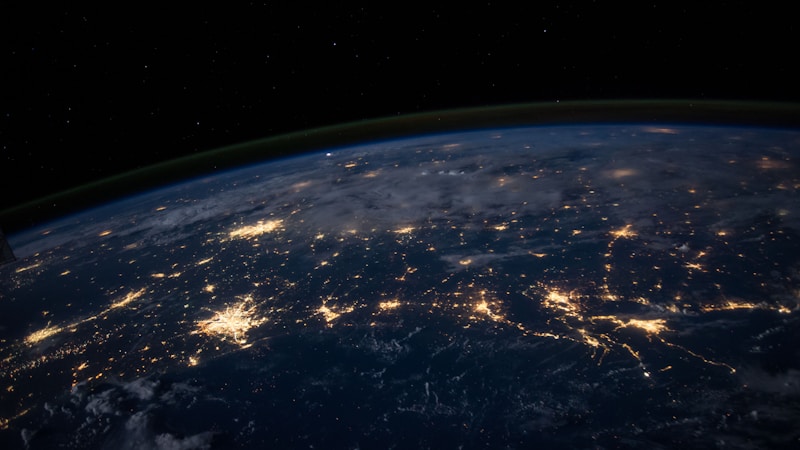
Photo credit: Unsplash
What Is a Magnetic Field?
A magnetic field is an invisible region of influence created by moving electric charges. When you hold a bar magnet, the field extends outward from the north pole, curves through space, and returns to the south pole — forming closed loops. Earth behaves like an enormous bar magnet, with field lines emerging near the geographic south pole and re-entering near the geographic north pole (yes, Earth's magnetic poles are reversed relative to geographic poles). This dipole field is generated by the geodynamo: convection currents of liquid iron in the outer core, 2,900 km below the surface, moving through the existing magnetic field and generating electric currents that sustain and strengthen the field in a self-reinforcing loop.
The field's strength at Earth's surface ranges from about 25 microtesla near the equator to 65 microtesla near the poles — roughly 100 times weaker than a refrigerator magnet. Yet this modest field, extended into space, is powerful enough to deflect the solar wind and create a protected bubble hundreds of thousands of kilometers across. The Physics Lab games let you experiment with magnetic fields at various scales.
The Solar Wind: A Constant Assault
The Sun doesn't just emit light — it also blows a continuous stream of plasma (ionized gas) into space. This solar wind consists mainly of protons and electrons traveling at 300–800 km/s, with a density of about 5–10 particles per cubic centimeter at Earth's distance. That sounds sparse, but the flux is relentless: roughly 1 million tonnes per second of material leaves the Sun in all directions.
During quiet conditions, the solar wind exerts gentle pressure on Earth's magnetosphere, compressing the Sun-facing side and stretching the night side into a long magnetotail extending millions of kilometers downwind. But the Sun is not always quiet. Coronal mass ejections (CMEs) — enormous eruptions of plasma and magnetic field — can launch billions of tonnes of material at speeds up to 3,000 km/s. When a CME hits Earth's magnetosphere, the result is a geomagnetic storm.
The Lorentz Force: How Deflection Works
The mechanism behind magnetic shielding is the Lorentz force, described by the equation F = qv × B, where q is the particle's charge, v is its velocity, and B is the magnetic field. The cross product (×) means the force is always perpendicular to both the particle's direction of travel and the magnetic field — it curves the particle's path without slowing it down.
This perpendicularity is what makes magnetic shielding so effective. A charged particle entering a magnetic field doesn't bounce off like a ball hitting a wall — it spirals. Positive charges (protons) spiral one way; negative charges (electrons) spiral the other. The radius of the spiral depends on the particle's speed and the field's strength: faster particles make wider spirals, stronger fields make tighter ones. In the Magneto-Mapper game, you can see this in action — red particles (positive) and blue particles (negative) curve in opposite directions, and your job is to adjust the field to deflect them all.
Standards alignment: This directly supports NGSS HS-PS2-5 (planning and conducting an investigation of the behavior of an object in a magnetic field) and connects to MS-ESS1-2 (Earth's place in the solar system, including the effects of the Sun on Earth).
Aurora Borealis and Aurora Australis
The aurora is the visible proof that Earth's magnetosphere is at work. While most solar wind particles are deflected, some manage to enter the magnetosphere by following magnetic field lines near the poles. These field lines act like funnels, channeling particles down into the upper atmosphere at altitudes of 100–300 km. When these high-energy particles collide with atmospheric gases, the atoms become excited — their electrons jump to higher energy levels and then release photons as they fall back down.
Different gases produce different colors. Oxygen is the most common source: at about 100 km altitude, excited oxygen atoms emit green light (557.7 nm wavelength), while above 200 km they produce a rarer red glow (630 nm). Nitrogen molecules contribute blue and purple hues when ionized. The result is the shimmering curtains of light visible from high latitudes — the aurora borealis in the north and the aurora australis in the south.
Auroras normally form in oval-shaped zones centered on the magnetic poles, between about 65° and 72° latitude. During strong geomagnetic storms, the auroral ovals expand equatorward, and people at latitudes as low as 40° (New York, Madrid, Beijing) can sometimes see auroral displays. The strongest recorded storm — the Carrington Event of 1859 — produced auroras visible in the tropics.
The Kp Index: Measuring Geomagnetic Activity
Space weather forecasters use the Kp index to quantify how disturbed Earth's magnetic field is at any given time. The scale runs from 0 to 9, derived from magnetometer measurements at 13 ground stations distributed around the world. NOAA's Space Weather Prediction Center updates the Kp value every three hours.
| Kp Value | Condition | Effects |
|---|---|---|
| 0–1 | Quiet | No noticeable effects. Aurora confined to high latitudes. |
| 2–4 | Unsettled to Active | Minor GPS fluctuations. Aurora visible at 60–65° latitude. |
| 5–6 | Minor to Moderate Storm | Satellite drag increases. HF radio intermittent. Aurora at 50–55°. |
| 7–8 | Strong to Severe Storm | Power grid voltage anomalies. GPS degraded. Aurora at 45–50°. |
| 9 | Extreme Storm | Widespread blackouts possible. Satellite damage. Aurora visible at 40°+. |
Kp 5 or above officially qualifies as a geomagnetic storm. The most severe events in recorded history include the Carrington Event (1859), which would have registered approximately Kp 9+, and the March 1989 storm (Kp 9) that caused the Hydro-Québec blackout, leaving 6 million people without power for 9 hours.
Geomagnetic Storms: When the Shield Is Tested
A geomagnetic storm begins when a burst of solar wind — typically from a coronal mass ejection — compresses the magnetosphere and injects extra energy into the system. The magnetopause (the outer boundary of the magnetosphere) can be pushed from its normal position at about 10 Earth radii (65,000 km) down to 6 or even 4 Earth radii during severe storms. This compression squeezes magnetic field lines together, intensifying currents in the ionosphere and inducing electric currents in long conductors on the ground: power lines, pipelines, railway tracks.
These geomagnetically induced currents (GICs) are the primary threat to infrastructure. In power grids, GICs flow through transformer windings, saturating their cores and causing overheating, harmonic distortion, and in extreme cases, permanent damage. The 1989 Hydro-Québec event took only 92 seconds from the first anomaly to complete grid collapse. Modern grids are better monitored but also more interconnected, meaning a cascading failure could be even more widespread.
Satellites face a different set of risks. Increased radiation degrades solar panels, upsets electronics, and causes spacecraft to accumulate static charge that can discharge destructively. During the October 2003 "Halloween Storms," one Japanese satellite was permanently lost and several others suffered anomalies. The expanding atmosphere during a storm also increases drag on low-orbit satellites, altering their trajectories — SpaceX lost 40 Starlink satellites to storm-enhanced drag in February 2022.
Mars: A World That Lost Its Shield
Mars provides a sobering case study. About 4 billion years ago, Mars had a global magnetic field similar to Earth's. Evidence comes from strongly magnetized patches of ancient crust detected by NASA's Mars Global Surveyor. But Mars's smaller size allowed its core to cool faster than Earth's, and as the liquid iron solidified, the geodynamo shut down. Without a magnetic shield, the solar wind began stripping away Mars's atmosphere. NASA's MAVEN mission (2014–present) measured the current atmospheric loss rate: about 100 grams per second, primarily oxygen and carbon dioxide ions.
Over billions of years, this slow erosion reduced Mars's atmospheric pressure from possibly Earth-like levels to just 0.6% of Earth's. The thinner atmosphere could no longer sustain liquid water on the surface, and Mars transformed from a potentially habitable world to the cold, dry desert we see today. It is the most vivid real-world example of what happens when a planet's magnetic shield fails — a concept you can explore further in our companion article on space weather physics.
Classroom Connection: Standards and Activities
This lesson connects to NGSS MS-ESS1-2 (the role of gravity and other forces in motions within the solar system) and HS-PS2-5 (planning investigations to show that an electric current can produce a magnetic field, and a changing magnetic field can produce an electric current). The Kp index table above provides real-world data students can use for analysis: what Kp level triggers aurora at their latitude? How often do Kp 7+ events occur? (Answer: a few times per solar cycle, roughly every 11 years.)
For hands-on reinforcement, the Magneto-Mapper game puts students in charge of a magnetic field. They adjust field strength and orientation to deflect incoming solar wind particles. The game visualizes the Lorentz force in real time, showing how positive and negative charges curve differently. After playing, students can connect their observations to the equation F = qv × B and explain why the force is perpendicular to both velocity and field direction. For a different physics challenge, try the thermodynamics puzzles.
Defend the Planet
You've learned how Earth's magnetic shield works — now see if you can operate one yourself. In Magneto-Mapper, the solar wind is coming and only your magnetic field stands between the particles and the planet.
Play Magneto-Mapper →Sources
- NOAA Space Weather Prediction Center. "Planetary K-index." swpc.noaa.gov.
- NASA Science. "Earth's Magnetosphere." science.nasa.gov.
- NASA MAVEN Mission. "Mars Atmosphere and Volatile EvolutioN." mars.nasa.gov/maven.
- NGSS Lead States. "Next Generation Science Standards: HS-PS2-5." nextgenscience.org.
Frequently Asked Questions
What is Earth's magnetosphere and why does it matter?
Earth's magnetosphere is the region of space surrounding our planet where Earth's magnetic field dominates over the solar wind. It extends about 65,000 km on the Sun-facing side and stretches millions of kilometers into a long tail on the opposite side. Without it, solar wind would strip away our atmosphere over geological time — exactly what happened to Mars, which lost its global magnetic field about 4 billion years ago.
What causes the aurora borealis and aurora australis?
Auroras occur when charged particles from the solar wind follow Earth's magnetic field lines toward the poles and collide with atmospheric gases. Oxygen atoms emit green light (at ~100 km altitude) and red light (above 200 km). Nitrogen molecules produce blue and purple hues. The ring-shaped auroral zones around each pole mark where field lines funnel particles into the atmosphere.
What is the Kp index and how is it measured?
The Kp index is a scale from 0 to 9 that quantifies geomagnetic disturbance caused by solar wind variations. It is derived from magnetometer readings at 13 ground stations worldwide, updated every 3 hours by NOAA's Space Weather Prediction Center. Kp 0-1 is quiet, Kp 2-4 is unsettled, Kp 5+ is a geomagnetic storm. At Kp 7-9, auroras can be visible at mid-latitudes and power grids may be disrupted.
How does the Magneto-Mapper game teach space weather?
In Magneto-Mapper, players adjust the strength and orientation of a magnetic field to deflect incoming charged particles (positive ions shown in red, negative electrons in blue). The game visualizes the Lorentz force in real time — players see how positive and negative charges curve in opposite directions and must protect a virtual planet. It builds intuition for F = qv × B without requiring calculus.