April 4, 2026
Ocean Waves, Superposition, and Real NOAA Buoy Data
Stand on any beach and watch the ocean. The surface looks chaotic — waves of different sizes arriving from different directions, crashing and merging and reforming. But hidden inside that apparent chaos is one of the most elegant principles in physics: superposition. Every complex wave pattern you see is simply the sum of many simpler waves, each with its own amplitude, frequency, and direction. Understanding this principle unlocks everything from ocean engineering to music to quantum mechanics.
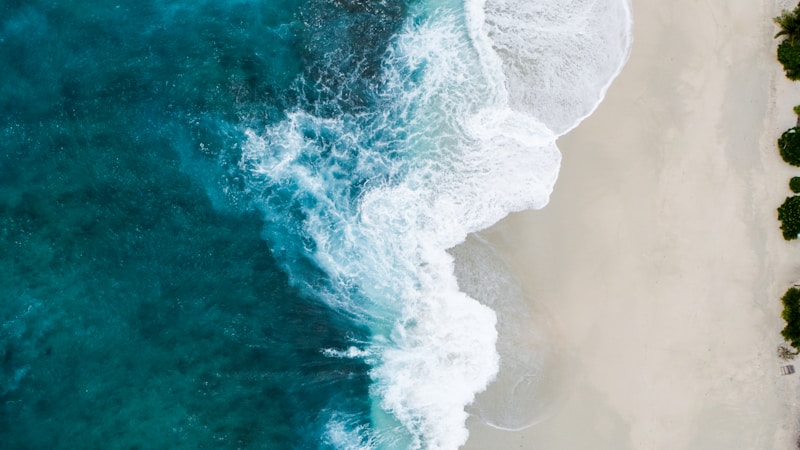
Photo credit: Unsplash
Anatomy of a Wave
Before we can understand how waves combine, we need to understand the language of a single wave. Every wave — whether it's an ocean swell, a sound wave, or light — can be described by four fundamental properties:
Amplitude is the maximum displacement from the resting position. For an ocean wave, this is half the distance from trough to crest. A gentle swell might have an amplitude of 0.5 meters. A storm wave might reach 7-8 meters. The largest wave ever reliably measured by a buoy was 19 meters (62 feet) in the North Atlantic in 2013, recorded by a buoy off Donegal, Ireland.
Wavelength is the distance between two consecutive crests (or two consecutive troughs). Open ocean swells typically have wavelengths of 100-300 meters. Wind chop has wavelengths as short as 1-2 meters. The wavelength determines how the wave interacts with structures — harbor walls, ships, and coastlines.
Frequency is how many complete wave cycles pass a fixed point per second, measured in hertz (Hz). Ocean waves are very low frequency — a typical swell with a 10-second period has a frequency of just 0.1 Hz. For comparison, the lowest note on a piano is 27.5 Hz, and visible light oscillates at about 500 trillion Hz.
Period is the inverse of frequency — the time for one complete wave cycle. NOAA buoys report wave period rather than frequency because it's more intuitive for ocean conditions. A period of 8-12 seconds indicates a mature, well-organized swell. Periods under 6 seconds indicate locally generated wind chop. Periods over 15 seconds indicate a powerful distant storm.
The Superposition Principle
The superposition principle states that when two or more waves overlap, the resulting displacement at any point is simply the algebraic sum of the individual displacements. Waves pass through each other without being permanently changed — they add up at the moment of overlap, then continue on their separate ways as if nothing happened.
This principle is remarkable because it means that no matter how complex a wave pattern looks, it can always be decomposed into simple sine waves. The mathematician Joseph Fourier proved this in 1807, and his insight — now called Fourier analysis — is one of the most powerful tools in all of science and engineering. When NOAA analyzes buoy data, they use Fourier transforms to decompose the messy ocean surface into its component waves, identifying each swell's individual period, direction, and energy.
The Wave Watcher game lets you see this decomposition in action. You start with simple sine waves and combine them, watching how the resulting pattern grows more complex. Then you try to reverse the process — given a complex wave pattern from real NOAA data, can you identify the component waves that created it?
Constructive and Destructive Interference
Superposition produces two dramatic effects depending on how wave crests and troughs align:
Constructive Interference
When wave crests align with crests (and troughs with troughs), their amplitudes add together. Two 2-meter waves perfectly in phase create a 4-meter wave. This is how rogue waves form at sea — multiple wave trains from different storms occasionally align perfectly, creating a wave far larger than any individual component. The famous Draupner wave, measured on January 1, 1995, by an oil platform in the North Sea, was a 25.6-meter rogue wave in seas with a significant wave height of only 12 meters.
Destructive Interference
When a wave crest aligns with a trough of equal magnitude, they cancel each other out. Perfect destructive interference produces zero displacement — the water surface is flat at that point. This principle is exploited by noise-cancelling headphones: microphones detect incoming sound waves, and the headphones generate an inverted copy that destructively interferes with the noise, producing silence. Breakwaters and seawalls are sometimes designed to exploit destructive interference, reflecting waves back at themselves.
In real ocean conditions, interference is rarely perfectly constructive or perfectly destructive. Most of the time, waves are partially in phase, producing complex patterns of peaks and dips. The significant wave height reported by NOAA — defined as the average height of the highest one-third of waves — is a statistical measure that captures this variability.
How NOAA Measures Waves: The Buoy Network
NOAA's National Data Buoy Center (NDBC) operates the most extensive ocean observation network in the world. Over 1,300 stations — including deep-ocean buoys, coastal stations, lake buoys, and ships — continuously measure wave conditions, wind, temperature, and atmospheric pressure.
Source: NOAA National Data Buoy Center. Buoy data is publicly available at ndbc.noaa.gov and is used by mariners, coastal engineers, climate scientists, and surfers worldwide.
Wave Energy: Why Amplitude Matters More Than You Think
A wave's energy is proportional to the square of its amplitude. This means doubling a wave's height doesn't double its energy — it quadruples it. A 4-meter wave carries 16 times the energy of a 1-meter wave. This is why storm waves are so destructive. The energy density of ocean waves is measured in kilowatts per meter of wave front. A typical Atlantic swell carries about 30-40 kW/m. A major storm swell can exceed 500 kW/m.
When constructive interference doubles the wave height, it quadruples the energy density at that point. This is one reason rogue waves are so dangerous — they don't just hit ships with a taller wall of water, they hit with exponentially more force. A 25-meter rogue wave in 12-meter seas delivers roughly 4.3 times the energy of the surrounding waves, concentrated in a single impact.
Superposition Beyond the Ocean
The superposition principle applies to all waves, not just ocean waves. Understanding it in one domain transfers directly to others:
Sound: Musical instruments produce complex tones by combining a fundamental frequency with harmonics (overtones). A violin and a flute playing the same note sound different because their harmonics combine differently through superposition. Audio engineers use this principle to mix tracks, apply equalization, and create spatial effects.
Light: The iridescent colors on a soap bubble or oil slick come from thin-film interference — light waves reflecting off the top and bottom surfaces of a thin layer and interfering constructively at wavelengths that depend on the film thickness. Anti-reflective coatings on camera lenses use destructive interference to eliminate unwanted reflections.
Quantum mechanics: The most profound application of superposition is in quantum physics, where particles exist in superpositions of states until measured. The double-slit experiment — where electrons create an interference pattern just like waves — demonstrates that superposition operates at the most fundamental level of reality.
Ride the Waves
Wave Watcher uses live NOAA buoy data to create wave challenges rooted in real ocean conditions. Combine wave components, predict interference patterns, and see how the math behind superposition produces the waves surfers ride and engineers design for. Explore more experiments in the Physics Lab.
Play Wave Watcher →Related Articles
Continue exploring physics with real data: learn how Ohm's Law governs electrical circuits using NREL energy data, or discover how the same wave principles apply in our full Physics Lab game collection.
Frequently Asked Questions
What is superposition in wave physics?
Superposition is the principle that when two or more waves occupy the same space at the same time, the resulting displacement at any point is the sum of the individual wave displacements. This means waves can pass through each other without being permanently altered. When wave crests align, they add together (constructive interference) creating a larger wave. When a crest meets a trough, they cancel out (destructive interference) creating a smaller wave or no wave at all.
How does NOAA measure ocean waves with buoys?
NOAA operates over 1,300 buoys and coastal stations through the National Data Buoy Center (NDBC). Most ocean wave measurements come from accelerometer-equipped buoys that bob freely on the surface. The accelerometer measures the buoy's vertical acceleration, which is then double-integrated to calculate displacement (wave height). Advanced buoys also measure pitch, roll, and compass heading to determine wave direction. Measurements are typically taken every hour, with wave statistics computed from 20-minute sampling windows that capture roughly 100-200 individual waves.
What is the difference between constructive and destructive interference?
Constructive interference occurs when two waves combine so their crests (or troughs) align, producing a wave with greater amplitude than either individual wave. Destructive interference occurs when a crest from one wave aligns with a trough from another, reducing the combined amplitude. Perfect destructive interference (complete cancellation) requires waves of equal amplitude and exactly opposite phase. This principle is used in noise-cancelling headphones, which generate sound waves that destructively interfere with ambient noise.
How does the Wave Watcher game simulate real ocean data?
Wave Watcher pulls real-time significant wave height, dominant wave period, and average wave period data from NOAA's National Data Buoy Center. Players manipulate wave parameters and observe how superposition creates complex wave patterns. The game shows how multiple simple sine waves combine to produce the chaotic-looking ocean surface that NOAA buoys actually measure — demonstrating that complex wave patterns are just the sum of simpler components.
Why are some ocean waves much bigger than others?
Ocean wave size depends on three factors: wind speed, wind duration (how long it blows), and fetch (the distance of open water over which the wind blows). Storms over large open ocean areas create the biggest waves because all three factors are maximized. Additionally, waves from different storms can travel thousands of kilometers and arrive at the same location at different times. When multiple wave trains combine through superposition, occasional 'rogue waves' can reach heights more than twice the significant wave height — a phenomenon that was considered a myth until satellite measurements confirmed it in 1995.
Sources
- NOAA National Data Buoy Center. "Station Information and Data." ndbc.noaa.gov.
- Holthuijsen, L.H. "Waves in Oceanic and Coastal Waters." Cambridge University Press, 2007.
- Haver, S. "A Possible Freak Wave Event Measured at the Draupner Jacket." Rogue Waves Workshop, 2004.
- Fourier, J. "Théorie analytique de la chaleur." 1822.
- NGSS Lead States. "Next Generation Science Standards." nextgenscience.org.
- WMO. "Guide to Wave Analysis and Forecasting." WMO-No. 702, 2018.