Earth
Earth is the third planet from the Sun, a rocky planet with a mass of 5.97 × 10²⁴ kg (1× Earth), an equatorial diameter of 12,756 km, and 1 moon, orbiting 1 AU from the Sun.
Earth is the third planet from the Sun and the only known world that supports life. Its unique combination of liquid water, a breathable atmosphere, and a protective magnetic field make it an oasis in the vastness of space. Earth is the largest of the four rocky planets and the densest planet in the solar system. Of the thousands of planets discovered orbiting other stars, none has yet been confirmed to host life. As far as we currently know, Earth remains one of a kind.
Think you know the planets? Test your solar system knowledge.
Play Solar System gamesKey Data
- Equatorial diameter
- 12,756 km
- Mass
- 5.97 × 10²⁴ kg
- Mass (Earth = 1)
- 1×
- Distance from Sun
- 1 AU
- Surface gravity
- 9.81 m/s²
- Average temperature
- 15°C
- Known moons
- 1
- Orbital period
- 365.3 Earth days
- Rotation period
- 23.9 hours
- Ring system
- No
Source: NASA Planetary Fact Sheets (nssdc.gsfc.nasa.gov)
Atmosphere
Nitrogen (78%), oxygen (21%), argon (0.9%), carbon dioxide (0.04%). Supports life and creates weather.
In Depth
Earth stands alone in the known universe as a cradle of life. Our planet's habitability depends on a remarkable combination of factors: a distance from the Sun that allows liquid water to exist (the 'habitable zone'), an atmosphere thick enough to retain heat but thin enough to allow sunlight through, and a magnetic field strong enough to deflect the solar wind. Earth's surface is 71% water, and the oceans contain about 1.335 billion cubic km of water.
Active plate tectonics recycle the crust, regulate the long-term carbon cycle by pulling carbon-rich rock into the mantle and releasing it back through volcanoes, and build mountains through continental collision. The atmosphere is primarily nitrogen and oxygen, a composition maintained by biological processes rather than geochemistry alone, since free oxygen is chemically reactive and would disappear within a few million years without photosynthetic life continuously replenishing it. That oxygen-rich atmosphere is itself a product of life: cyanobacteria began producing oxygen as a waste product roughly 2.4 billion years ago, triggering the Great Oxidation Event that reshaped the planet's chemistry and eventually made complex, oxygen-breathing life possible. Beneath the surface, Earth is built in layers: a thin rocky crust just 5-70 km thick, a hot, slowly flowing mantle extending to about 2,900 km depth, a liquid iron-nickel outer core reaching to roughly 5,150 km, and a solid inner core at the planet's center, kept solid by immense pressure despite temperatures approaching that of the Sun's surface. Earth's single large moon, unusually massive compared to its parent planet among the rocky worlds, is thought to have formed when a Mars-sized protoplanet, sometimes called Theia, collided with the young Earth roughly 4.5 billion years ago, flinging debris into orbit that coalesced into the Moon. That moon's gravity stabilizes Earth's axial tilt at about 23.4°, preventing the chaotic tilt swings seen on Mars and giving us predictable seasons, while its tidal pull gradually slows Earth's rotation and is itself slowly spiraling the Moon away from Earth.
The planet's liquid iron outer core, churned by heat escaping from the inner core, generates a magnetic field extending thousands of kilometers into space, forming the magnetosphere that shields all surface life from harmful solar and cosmic radiation and produces the aurora borealis and aurora australis where charged particles funnel down near the poles. Earth formed about 4.54 billion years ago, and the earliest evidence of life dates to roughly 3.7 billion years ago, meaning life has existed for more than 80% of the planet's history. Earth's orbit is also not perfectly circular or fixed: its eccentricity, axial tilt, and the direction its axis points all shift slowly over tens of thousands of years in patterns known as Milankovitch cycles, which climate scientists believe helped pace the timing of past ice ages.
Notable Features
- 01
The only known planet to harbor life
- 02
71% of the surface covered by liquid water oceans
- 03
A strong magnetic field generated by a liquid iron outer core
- 04
Active plate tectonics constantly reshaping the surface
- 05
An unusually large moon relative to its own size, among rocky planets
- 06
A layered atmosphere: troposphere, stratosphere, mesosphere, thermosphere, and exosphere, each with distinct temperature and chemistry
Try It Yourself
Exploration & Missions
Earth is the most studied planet in the solar system. Thousands of satellites orbit it, monitoring weather, climate, land use, and ocean conditions.
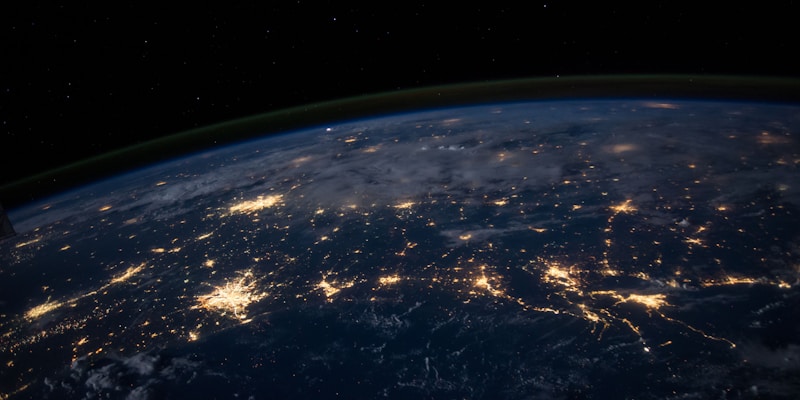
The first photograph of Earth from space was taken in 1946 from a V-2 rocket launched from White Sands, New Mexico. The iconic 'Blue Marble' photo taken by Apollo 17 astronauts in 1972 became one of the most reproduced images in history, and the 2012 Suomi NPP satellite composite known as the 'Black Marble' offered a similarly iconic nighttime view of city lights across the globe. NASA's Earth Observing System includes missions like Terra, Aqua, and the Landsat series (continuously imaging Earth's land surface since 1972, the longest continuous satellite record of any kind), providing uninterrupted global observations for decades. Weather satellites such as the GOES series have tracked hurricanes and storm systems since the 1970s, while ESA's Copernicus Sentinel fleet adds high-resolution environmental monitoring. Dedicated climate missions like ICESat-2 measure ice-sheet thickness with laser altimetry to track polar ice loss.
The ISS has orbited Earth continuously since November 2000 with human crews aboard, and since 2020 commercial spacecraft like SpaceX's Crew Dragon have joined government vehicles in ferrying astronauts to and from orbit, making low Earth orbit more accessible than at any point in the Space Age.
Fun Facts
Earth is the densest planet in the solar system at 5.51 g/cm³, largely due to its iron-nickel core.
The deepest point on Earth, Challenger Deep in the Mariana Trench, is 10,935 meters below sea level, deeper than Mount Everest is tall.
Earth's rotation is gradually slowing: days were about 22 hours long 600 million years ago.
About 97% of Earth's water is saltwater; only 3% is fresh, and most of that is locked in ice caps.
Earth is the only planet in the solar system not named after a Greek or Roman god. Its name comes from Old English and Germanic words simply meaning 'ground' or 'soil.'
There is no sharp edge where Earth's atmosphere ends and space begins; the internationally recognized boundary, the Kármán line, sits 100 km up, but trace gases linger for hundreds of kilometers beyond it.
Frequently Asked Questions
Why is Earth called the Blue Planet?▾
When viewed from space, Earth appears predominantly blue because its oceans cover about 71% of the surface. Water absorbs red wavelengths of light and reflects blue wavelengths, giving the planet its distinctive color. The nickname was popularized after astronauts first saw Earth from space.
How old is Earth?▾
Earth is approximately 4.54 billion years old, determined by radiometric dating of meteorites and the oldest known Earth rocks. The oldest mineral grains (zircons) found on Earth are about 4.4 billion years old, suggesting the crust formed relatively quickly after the planet's formation.
What protects Earth from the Sun's radiation?▾
Earth has two main shields. The magnetic field (magnetosphere) deflects most charged particles from the solar wind. The ozone layer in the stratosphere absorbs about 97-99% of the Sun's harmful ultraviolet radiation. Together, they make the surface safe for life.
What is inside Earth?▾
Earth has four main layers: a thin rocky crust (5-70 km thick), a hot semi-solid mantle extending to about 2,900 km, a liquid iron-nickel outer core reaching roughly 5,150 km, and a solid iron-nickel inner core at the center. Heat and motion in the liquid outer core generate Earth's magnetic field.
How did Earth's Moon form?▾
The leading explanation is the giant-impact hypothesis: about 4.5 billion years ago, a Mars-sized protoplanet nicknamed Theia is thought to have collided with the young Earth. Debris from the collision coalesced in orbit to form the Moon, which explains its composition and Earth's unusually fast early rotation.
Learn More
The 8 Planets in Order: An Interactive Guide for Students — an in-depth article covering all 8 planets, with size comparisons and learning activities.
Data source: NASA Planetary Fact Sheets
Play Solar System games →
Scale Detective, Planet ID, Gravity Slingshot, and more — powered by real NASA data.