March 25, 2026
How Do Spacecraft Land on Other Worlds?
On February 18, 2021, the Perseverance rover entered the Martian atmosphere traveling at 19,500 km/h. Seven minutes later, it was sitting motionless on the surface of Jezero Crater, lowered by a rocket-powered sky crane on nylon cables. Between those two moments, a sequence of over 500,000 lines of autonomous code executed flawlessly — because at Mars distance, no human could intervene. This is the story of how we land on other worlds.
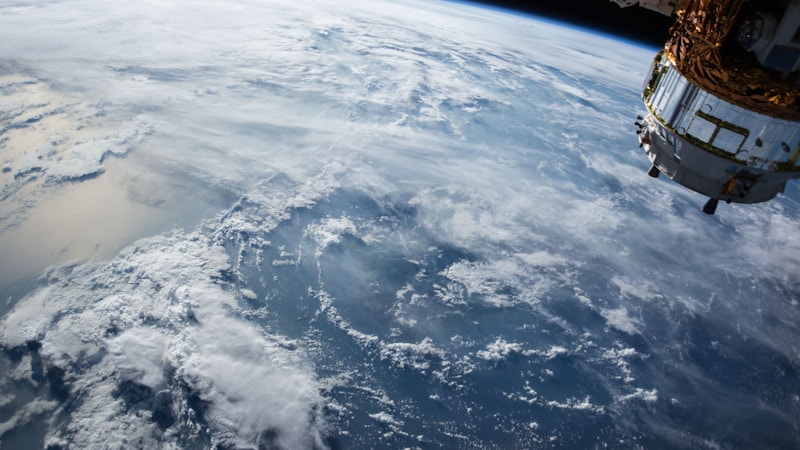
Photo credit: Unsplash
The Fundamental Problem: Too Fast, Too High, No Runway
Every planetary landing begins with the same challenge. A spacecraft arrives at its destination traveling at orbital velocity — typically thousands of meters per second. It needs to reach the surface at nearly zero velocity. On Earth, airplanes solve this with wings and long runways, but most solar system bodies lack thick atmospheres, flat terrain, or both. Engineers must shed all that kinetic energy using whatever tools the destination provides.
According to NASA's Planetary Fact Sheet, Mars has an atmospheric surface pressure of only 0.636 kPa — less than 1% of Earth's 101.3 kPa. That thin atmosphere provides some aerodynamic braking, but not nearly enough to slow a heavy spacecraft to landing speed. The Moon has no atmosphere at all — every meter per second of velocity must be canceled by rocket thrust. Titan, Saturn's largest moon, has an atmosphere 1.5 times denser than Earth's, making parachutes remarkably effective. Each destination demands a completely different landing architecture.
The Moon: Powered Descent and Human Reflexes
The Apollo Lunar Module remains one of the most elegant landing machines ever built. With no atmosphere to exploit, the entire descent from orbit to surface relied on a single throttleable descent engine producing up to 45,000 newtons of thrust. The engine burned a hypergolic propellant mix — aerozine 50 and nitrogen tetroxide — chosen because hypergolics ignite on contact, eliminating the risk of a failed ignition at the worst possible moment.
Apollo 11's landing on July 20, 1969, nearly ended in disaster. The onboard guidance computer, running on just 74 kilobytes of memory, threw multiple "1202" alarms during descent — the processor was being overwhelmed by unnecessary radar data. Mission Control determined the alarms were non-critical and called "go." Then Neil Armstrong noticed the computer was steering toward a boulder field. He took manual control, flew laterally to find a clear spot, and landed with only 25 seconds of fuel remaining. Every Apollo landing after that carried more fuel margin and better terrain avoidance, but the fundamental approach — powered descent with a human pilot ready to intervene — remained the same.
Mars: The Seven Minutes of Terror
Mars is uniquely difficult. Its thin atmosphere is thick enough to generate extreme heating during entry — temperatures exceeding 1,300 degrees Celsius on the heat shield — but too thin for parachutes alone to slow a lander to safe speeds. The result is that every Mars landing requires a multi-phase approach that JPL engineers call "entry, descent, and landing" or EDL.
NASA has used four distinct EDL architectures on Mars. The Viking landers (1976) used a heat shield, parachute, then retrorockets. Mars Pathfinder (1997) added airbags — the lander bounced across the surface like a beach ball, coming to rest after 15 bounces. Spirit and Opportunity (2004) used the same airbag approach. But Curiosity (2012) was too heavy for airbags at 899 kg, so JPL invented the sky crane: a hovering platform that lowered the rover on cables, then flew away to crash at a safe distance. Perseverance used the same system but added terrain-relative navigation, comparing camera images against onboard maps to steer toward the safest landing spot in real time.
The entire EDL sequence from atmospheric entry to touchdown takes about seven minutes. Because Mars is between 4 and 24 light-minutes from Earth, depending on orbital positions, the spacecraft must execute everything autonomously. By the time ground controllers receive the signal that EDL has begun, the rover has already been on the surface — or crashed — for several minutes. There is no joystick, no abort button, no second chance.
Titan: Parachuting Through an Alien Sky
In January 2005, ESA's Huygens probe achieved something remarkable: it landed on Titan, Saturn's largest moon, after a 2 hour and 27 minute parachute descent through the thickest atmosphere in the outer solar system. Titan's nitrogen-rich atmosphere has a surface pressure of 146.7 kPa — about 45% higher than Earth's — and its low gravity (1.35 m/s² versus Earth's 9.8 m/s²) meant the probe descended gently enough to take photos and measure atmospheric composition the entire way down.
Huygens used three parachutes in sequence. A small pilot chute deployed first, pulling away the heat shield. Then a large 8.3-meter main parachute deployed to stabilize and slow the probe. After 15 minutes, the main chute was released and a smaller 3-meter drogue took over — the engineers intentionally sped up the descent to ensure the batteries lasted until landing. The probe continued transmitting from the surface for 72 minutes, revealing a landscape of rounded ice pebbles, hydrocarbon dunes, and a surface temperature of -179 degrees Celsius. It remains the most distant landing ever achieved.
Asteroids and Comets: Landing on Almost Nothing
Landing on a small body presents the opposite problem from landing on a planet: there's essentially no gravity to work with. The asteroid Ryugu, visited by JAXA's Hayabusa2 mission, has a surface gravity of approximately 0.00011 m/s² — about 100,000 times weaker than Earth's. A human standing on Ryugu could jump into orbit by flexing their calves. Conventional landing techniques don't work because there's barely any force pulling the spacecraft down.
ESA's Philae lander, which touched down on Comet 67P/Churyumov-Gerasimenko in November 2014, was designed with harpoons and ice screws to anchor itself. Neither worked. The lander bounced twice, drifting for nearly two hours before coming to rest in a shadowed crevice where its solar panels couldn't charge. Despite the rough landing, Philae returned 60 hours of science data before its batteries died. The lesson shaped every subsequent small-body mission: you don't really "land" on asteroids and comets so much as gently touch them and hope you stick.
The Future: Bigger, Heavier, Farther
The next generation of planetary landings will push every boundary. NASA's Artemis program aims to return astronauts to the lunar surface using SpaceX's Starship as a Human Landing System — a vehicle 50 meters tall, far larger than anything previously landed on another world. Mars sample return will require a rocket launch from the Martian surface, a first in planetary exploration. And concepts for landing on Europa, Jupiter's ice moon, must contend with intense radiation, an unknown surface texture, and a communication delay of up to 53 minutes.
Each destination in the solar system presents unique constraints — gravity, atmosphere, terrain, temperature, radiation, communication delay — and the landing system must be purpose-built for that specific combination. There is no universal lander. That's what makes planetary EDL one of the hardest engineering disciplines in existence, and why a successful landing on any new world is celebrated as one of humanity's greatest achievements.
Try It Yourself
Ready to attempt your own planetary descent? In Landing Sequence, you'll manage thrust, altitude, and fuel as you guide a lander to the surface of different solar system bodies. Each world has different gravity and atmosphere — what works on Mars won't work on the Moon.
Play Landing Sequence →Sources
- NASA Planetary Fact Sheet. "Planetary Atmospheric Parameters." nssdc.gsfc.nasa.gov.
- ESA Space Science. "Huygens: Titan Landing." esa.int/Science_Exploration.
- NASA Jet Propulsion Laboratory. "Mars 2020 Perseverance Rover: Entry, Descent, and Landing." mars.nasa.gov.