April 4, 2026
50 States in 5 Minutes: How to Learn US Geography Fast
Most people try to learn the 50 states alphabetically. That's the slowest possible method — Alabama and Alaska are next to each other in the alphabet but 3,000 miles apart on the map. Your brain learns geography spatially, not alphabetically. Here's a 5-day plan that works with your brain instead of against it, plus a free interactive map game to lock it in.
This guide is study material for the 50 States Learning Path — 5 region-by-region lessons with real data and map checkpoints.
Why Regional Grouping Beats Alphabetical
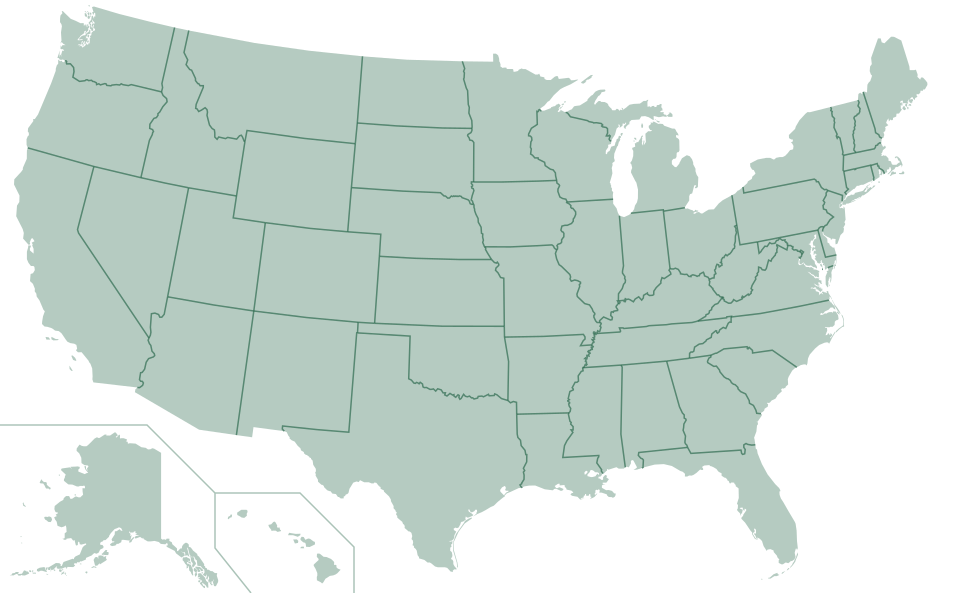
Cognitive scientists call it chunking — the brain's strategy of grouping related items into larger units to reduce memory load. When you learn the West Coast states together (Washington, Oregon, California), you build a spatial "chunk" — a mental map of that coastline. Each new state you add to the chunk snaps into its correct position relative to what you already know.
Alphabetical order destroys chunks. Alabama, Alaska, Arizona, Arkansas — four states scattered across the map with no spatial relationship. You're forcing your brain to store 50 isolated facts instead of 5 connected regions. Our detailed guide to learning all 50 states covers additional methods, but regional grouping is the foundation.
The 5-Day Learning Plan
Each day, learn one region. Spend 10 minutes studying the map, then lock it in with practice. Focus on your target region, but try to locate the previous day's states too — that's spaced repetition in action.
🗺️Play Just States — Free 50-State Map Quiz →All 50 states, 10 seconds each. No login required. Test yourself after each day's study session.Shape Mnemonics That Stick
Some states have shapes so distinctive they're impossible to confuse. Use these as anchors — once you know these, the states around them fall into place:
 MichiganMitten + rabbit
 FloridaHanging peninsula
 LouisianaBoot shape
 TexasLone star shape
 CaliforniaLong coastline
 OklahomaPan with handle
 IdahoFace looking left
 MinnesotaSquare with bump
For more shape-based learning, try the State Nicknames Quiz — many nicknames reference geographic features that help with visual identification.
Spaced Repetition: The Science of Not Forgetting
Learning the states once isn't enough — you need to review at increasing intervals to move knowledge from short-term to long-term memory. This is called spaced repetition, and it's the most evidence-backed learning technique in cognitive science.
After completing the 5-day plan, play Just States once per day for a week, then every other day, then twice a week. By the end of three weeks, you'll be able to identify all 50 states in under 5 minutes without hesitation. The timed format (10 seconds per state) prevents over-thinking and builds automatic recall.
For a deeper daily challenge, the Daily GeoProwl game gives you data clues about mystery states — population, agriculture, climate data from real government sources. It's a different kind of state knowledge: not just where a state is, but what makes it unique.
The States Everyone Gets Wrong
Based on data from Just States gameplay, these are the most commonly confused pairs:
Beyond Location: Know Your States
Once you can locate all 50 states, deepen your knowledge with data. Every state has a Fast Facts page with real government data — population, median income, agriculture, public health, climate, and national parks. Browse the full game catalog for more ways to build geographic knowledge, from state capitals to continent maps, or test what stuck with 50 trivia questions ranked by difficulty.
Continue the 50 States Learning Path →
5 region lessons, each with real data and a map checkpoint.
Frequently Asked Questions
What is the fastest way to learn all 50 states?
Region-based grouping combined with daily map practice is the fastest method. Learn 8-12 states per day by region (West Coast, Mountain West, Midwest, South, Northeast) rather than alphabetically. Use an interactive map quiz like Just States to test yourself daily — spatial memory forms faster through repeated clicking than through flashcards. Most people can confidently identify all 50 states within 5-7 days using this method.
What are the best games for learning US states?
GeoProwl's Just States game is a timed 50-state map quiz — you get 10 seconds per state, which builds speed and spatial memory. For a clue-based approach, the daily GeoProwl game gives you Census, USDA, and climate data about a mystery state. Rank File lets you order states by population, area, and other metrics. All are free and require no login.
How many states can the average American identify on a map?
Studies suggest the average American adult can correctly identify about 35-40 states on a blank map. The states most commonly missed are small northeastern states (Rhode Island, Connecticut, Vermont, New Hampshire), states with similar shapes in the Great Plains (Kansas, Nebraska, Iowa), and states that people confuse with their neighbors (Missouri/Arkansas, Alabama/Mississippi).
Does the regional grouping strategy really work?
Yes — cognitive science research on 'chunking' shows that grouping related items reduces cognitive load. Learning California, Oregon, and Washington together is easier than learning them separately because you build a spatial mental model of the West Coast. Each new state you add to a region snaps into place relative to the ones you already know, rather than floating in isolation.
What age is appropriate for learning all 50 states?
Most US education standards introduce state identification between 3rd and 5th grade (ages 8-10). However, the Just States game is accessible to children as young as 6-7 if they have basic mouse/touchscreen skills. For younger children, start with their home state and its neighbors, then expand outward. The 5-day regional plan works well for grades 3 and up.