April 4, 2026
Teaching Gravity and Orbital Mechanics with Interactive Simulations
Gravity is the most familiar force in the universe — every student has dropped something — yet it governs phenomena so vast that intuition breaks down completely. How do you teach a 12-year-old that the same force pulling their pencil to the floor also keeps the Moon in orbit and bends spacecraft trajectories across billions of kilometers? The answer is interactive simulation: let them play with gravity and watch what happens.
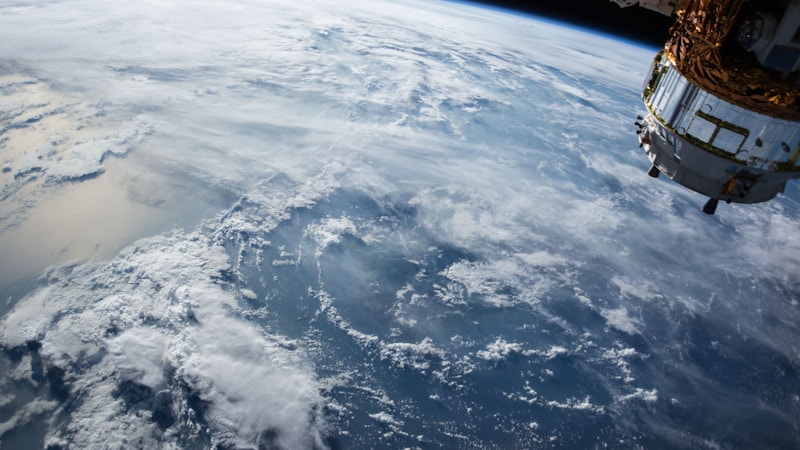
Photo credit: Unsplash
Newton's Law of Universal Gravitation
In 1687, Isaac Newton published the Principia Mathematica and introduced a single equation that explains everything from falling apples to orbiting planets: F = GMm/r². This formula says that every object with mass attracts every other object with mass, and that the force depends on two things — the product of their masses and the inverse square of the distance between them.
The "inverse square" part is where students' intuition usually fails. Doubling the distance doesn't halve the gravitational force — it quarters it. Triple the distance and the force drops to one-ninth. This rapid falloff is why the Moon (384,400 km away) experiences only about 0.00028% of the gravitational acceleration that objects on Earth's surface feel, even though it orbits a very massive body.
In our Gravity Slingshot game, students see this law in action. When they launch a probe past a planet, the gravitational pull increases dramatically as the probe approaches — and weakens just as dramatically as it recedes. The path curves, and the tightness of that curve depends entirely on mass and distance. No memorization needed. The equation becomes visible.
Kepler's Three Laws of Planetary Motion
Before Newton explained why planets move as they do, Johannes Kepler described how they move by analyzing Tycho Brahe's decades of astronomical observations. Kepler's three laws remain fundamental to orbital mechanics today.
First Law (Ellipses): Every planet's orbit is an ellipse with the Sun at one focus. This was revolutionary because the ancient assumption was that orbits were perfect circles. In reality, Earth's orbit has an eccentricity of 0.017 — nearly circular but not quite. Mars has an eccentricity of 0.093, which is why its distance from the Sun varies by about 42 million kilometers over the course of its year.
Second Law (Equal Areas): A line from the Sun to a planet sweeps out equal areas in equal times. When a planet is closer to the Sun (perihelion), it moves faster; when farther away (aphelion), it moves slower. Earth moves about 3.4% faster at perihelion (January) than at aphelion (July). Students can observe this directly in the Orbital Mechanic game when their probe speeds up near a planet and slows as it moves away.
Third Law (Harmonic Law): The square of a planet's orbital period is proportional to the cube of its semi-major axis. Written as T² = ka³, this law lets us calculate that Mars (1.524 AU from the Sun) takes about 1.88 Earth years to orbit, and Neptune (30.07 AU) takes 164.8 years. Students can verify these relationships using the planet data tables that appear in GeoProwl's solar system games.
Surface Gravity Across the Solar System
Surface gravity depends on both a body's mass and its radius. A planet can be very massive but have low surface gravity if its radius is large (gas giants are puffy). This table shows how a 70 kg person would weigh on each world:
Notice that Saturn — 95 times Earth's mass — has only slightly higher surface gravity than Earth. That's because Saturn's radius is 9.4 times Earth's. The Landing Sequence game uses these real gravity values for each level, so landing on the Moon requires very different thrust management than landing on Mars.
Gravity Assists: The Free Speed Boost
A gravity assist — also called a gravitational slingshot — is one of the most counterintuitive concepts in physics education. A spacecraft can gain speed without burning any fuel, simply by flying past a moving planet. How? Relative to the planet, the spacecraft's speed doesn't change. But relative to the Sun, the spacecraft picks up the planet's orbital velocity. It's the same principle as throwing a tennis ball at a moving train: the ball bounces back faster than it arrived.
NASA's Voyager 2 used four consecutive gravity assists — Jupiter, Saturn, Uranus, Neptune — to complete a "Grand Tour" that would have been impossible with fuel alone. Jupiter alone added roughly 10 km/s to Voyager's velocity. The Cassini mission to Saturn used a Venus-Venus-Earth-Jupiter chain to gain the 20 km/s it needed. For a deep dive into how these maneuvers work and why timing matters, see our article on gravity assists and launch windows.
In the Gravity Slingshot game, students must aim their probe to swing past planets at the right angle. Too close and the probe crashes. Too far and the gravitational bend is too weak. The sweet spot is where the probe gains maximum velocity change — and finding it builds exactly the intuition that professional trajectory planners develop over years of training.
Why Simulations Work Better Than Textbooks
Physics education research consistently shows that interactive engagement produces deeper conceptual understanding than passive instruction. The PhET project at the University of Colorado found that students using interactive simulations scored an average of 25% higher on conceptual assessments than students receiving traditional lectures on the same material.
The reason is straightforward: orbital mechanics involves variables changing simultaneously in nonlinear ways. A textbook can show a diagram of an elliptical orbit, but it cannot let a student drag the launch angle and watch the orbit reshape in real time. It cannot let them double a planet's mass and immediately see the probe's path tighten. These cause-and-effect relationships are what build genuine physical intuition — and they require interaction.
GeoProwl's physics games are designed around this principle. Every variable a student changes produces an immediate, visible result. The Orbital Mechanic game shows force vectors, velocity arrows, and energy bars in real time. Students don't memorize that gravitational potential energy converts to kinetic energy — they watch the energy bar shift as their probe falls toward a planet and speeds up.
NGSS Standards Alignment
This lesson and its associated games align directly to the following Next Generation Science Standards:
MS-PS2-4 (Middle School)
Construct and present arguments using evidence to support the claim that gravitational interactions are attractive and depend on the masses of interacting objects. Game connection: In Gravity Slingshot, students observe that more massive planets bend the probe's path more strongly, providing direct visual evidence of mass-dependent gravitational attraction.
HS-PS2-4 (High School)
Use mathematical representations of Newton's law of gravitation to describe and predict gravitational forces between objects. Game connection: The Orbital Mechanic science overlay displays the actual F = GMm/r² calculation in real time, showing how force magnitude changes as distance varies. Students can compare predicted and observed trajectories.
Classroom Activity: The Slingshot Challenge
Here is a structured 45-minute activity you can run with any class that has access to web browsers:
Warm-up (5 min): Ask students to predict what happens if you throw a ball sideways off a tall building. They should recognize that gravity pulls it downward while forward momentum carries it horizontally — creating a curved path. This is the same principle that governs orbits.
Guided Play (15 min): Have students open the Gravity Slingshot game and complete the first two levels. Ask them to record the launch angle and resulting closest-approach distance for three attempts. Which angle produced the tightest curve?
Investigation (15 min): Challenge students to reach the target using a gravity assist — no direct path allowed. They must use a planet's gravity to redirect their probe. Have them sketch the trajectory on paper and label where the probe sped up and slowed down.
Discussion (10 min): Compare strategies across the class. Did anyone find multiple paths to the same target? Introduce the concept that NASA mission planners evaluate hundreds of possible trajectories for each mission and select the one that minimizes fuel while meeting timing constraints.
Try the Games
All three games use real physical constants and NASA planet data. No accounts needed — just open and play.
Frequently Asked Questions
How does gravity work in space if there is no air?
Gravity has nothing to do with air. It is a fundamental force between any two objects that have mass. In space, gravity is actually the dominant force — it holds the Moon in orbit around Earth, Earth in orbit around the Sun, and the entire solar system together. Astronauts on the International Space Station experience microgravity not because there is no gravity (gravity at ISS altitude is about 90% of surface gravity) but because they are in continuous free fall around Earth.
What are Kepler's three laws of planetary motion?
Kepler's First Law states that planets orbit in ellipses with the Sun at one focus. The Second Law (equal areas) states that a line from the Sun to a planet sweeps out equal areas in equal times — meaning planets move faster when closer to the Sun. The Third Law states that the square of a planet's orbital period is proportional to the cube of its average distance from the Sun (T² ∝ a³), which lets us calculate how long any orbit takes if we know its size.
How do interactive simulations help students learn orbital mechanics?
Simulations let students manipulate variables like launch angle, velocity, and planet mass to see immediate consequences — something impossible with textbook diagrams. Research in physics education shows that interactive simulations improve conceptual understanding by 20-40% compared to traditional instruction because students build intuition through experimentation rather than memorization.
What NGSS standards does this lesson align to?
This lesson aligns to NGSS MS-PS2-4 (construct and present arguments using evidence to support the claim that gravitational interactions are attractive and depend on the masses of interacting objects) and HS-PS2-4 (use mathematical representations of Newton's law of gravitation to describe and predict gravitational forces between objects). It also touches on MS-ESS1-2 for planetary motion patterns.
Can I use the GeoProwl games in my classroom?
Yes. The Gravity Slingshot, Landing Sequence, and Orbital Mechanic games are free browser-based simulations that work on any device with a modern web browser. No accounts or downloads are required. Each game uses real NASA data for planet positions and physical constants, making them suitable for middle school through introductory college physics.
Sources
- Newton, I. "Philosophiae Naturalis Principia Mathematica." 1687.
- Kepler, J. "Astronomia Nova" (1609) and "Harmonices Mundi" (1619).
- NASA JPL. "Basics of Space Flight — Chapter 3: Gravity & Mechanics." science.nasa.gov.
- PhET Interactive Simulations. "Research — Effectiveness of Simulations." phet.colorado.edu.
- NGSS Lead States. "Next Generation Science Standards." nextgenscience.org.
- NASA JPL. "Horizons System." ssd.jpl.nasa.gov/horizons/.