
Alabama
AL · Data from 2022–2023 government sources · Southeast · 50 States Learning Path
Alabama, known as the Heart of Dixie, is a southeastern state rich in Civil Rights history and natural beauty. From the Gulf Coast beaches of Mobile Bay to the foothills of the Appalachian Mountains in the north, Alabama offers a diverse landscape that has shaped its culture and economy for centuries. The state played a pivotal role in the American Civil Rights Movement, with Montgomery serving as its epicenter.
Think you know Alabama? Test your geography skills.
History
Alabama became the 22nd state admitted to the Union on December 14, 1819. Before European colonization, the region was home to Cherokee, Chickasaw, Choctaw, and Creek peoples. The state's name derives from the Alabama tribe of the Muscogee language family. During the Civil War, Montgomery served briefly as the first capital of the Confederacy. In the 20th century, Alabama became ground zero for the Civil Rights Movement — the Montgomery Bus Boycott of 1955, the Selma to Montgomery marches of 1965, and the Birmingham church bombing of 1963 are defining moments in American history.
Economy
Alabama's economy has evolved from its agricultural roots into a diversified mix of aerospace, automotive manufacturing, and technology. Huntsville is home to NASA's Marshall Space Flight Center and a growing tech corridor. The automotive sector includes assembly plants for Honda, Hyundai, Mercedes-Benz, and Mazda-Toyota. Agriculture remains important, with poultry, cattle, and cotton among the top commodities.
Geography & Landmarks
Alabama spans approximately 52,420 square miles, stretching from the Tennessee Valley in the north to the Gulf of Mexico in the south. The state features six distinct geographic regions: the Cumberland Plateau, the Ridge and Valley region, the Piedmont Upland, the Black Belt prairie, the Coastal Plain, and the Gulf Coast. The Mobile-Tensaw River Delta, the second-largest river delta in the United States, is a biodiverse wetland ecosystem. The Sipsey Wilderness in the Bankhead National Forest contains over 25 miles of sandstone canyons and is one of the most biodiverse areas in the eastern United States. Alabama's highest point, Cheaha Mountain, reaches 2,413 feet in the Talladega National Forest.
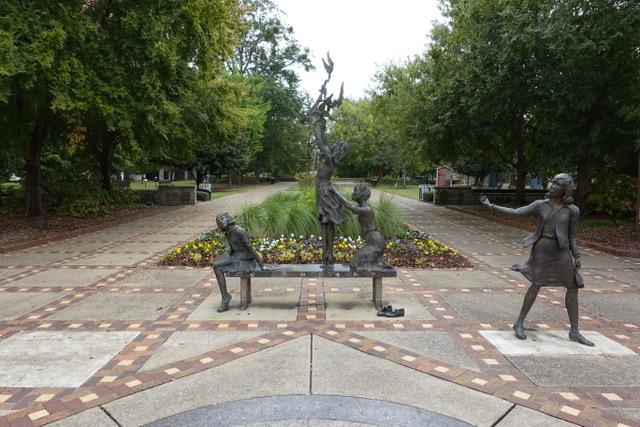
Birmingham Civil Rights National Monument — NPS Photo
Source: NPS API
Culture & Traditions
Alabama's cultural identity is deeply rooted in music, from the Muscle Shoals sound that produced hits for Aretha Franklin, Wilson Pickett, and The Rolling Stones to the rich gospel and blues traditions of the Black Belt region. The state is a college football powerhouse, with the Alabama-Auburn rivalry (the Iron Bowl) ranking among the most intense in all of American sports. Birmingham's food scene has earned national recognition, particularly for its barbecue tradition and the iconic Dreamland Bar-B-Que founded in 1958. The Alabama Shakespeare Festival in Montgomery is one of the largest Shakespeare festivals in the world, and the state has produced literary giants including Harper Lee, author of To Kill a Mockingbird.
Notable Cities
Montgomery
CapitalThe state capital and Cradle of the Confederacy turned cradle of the Civil Rights Movement. Home to the Rosa Parks Museum and the National Memorial for Peace and Justice.
199,819
Population
$54,166
Median income
$141,900
Home value
$1,026
Median rent
36.1
Median age
7.0%
Unemployment
53.5%
Homeownership
25,052
Bachelor's+
Birmingham
Alabama's largest city and a former steel industry powerhouse. The Birmingham Civil Rights Institute and 16th Street Baptist Church are landmark sites.
Huntsville
Known as Rocket City for its NASA connections. The U.S. Space & Rocket Center draws visitors from around the world.
Mobile
A port city on the Gulf Coast that claims America's original Mardi Gras celebration, predating New Orleans by several years.
Tuscaloosa
Home to the University of Alabama and its storied Crimson Tide football program, one of the most successful in college sports history.
Capital city data: Census Bureau ACS 5-Year (2022)
Intel File · Fun Facts
Mobile, Alabama hosted the first Mardi Gras celebration in the United States in 1703, fifteen years before New Orleans.
The Saturn V rocket that carried astronauts to the Moon was developed at NASA's Marshall Space Flight Center in Huntsville.
Alabama is the only state with all major natural resources needed to make iron and steel.
The world's first electric trolley system began operation in Montgomery in 1886.
Muscle Shoals, Alabama has been called the Hit Recording Capital of the World, producing legendary recordings for Aretha Franklin, The Rolling Stones, and many others.
Printable Worksheet
Free, GeoProwl-branded, classroom-ready.
Download the Alabama Worksheet (PDF)
One page · ready to print at home or in class
Nickname
The Yellowhammer State
Motto
Audemus Jura Nostra Defendere (We Dare Defend Our Rights)
State Bird
Yellowhammer
State Flower
Camellia
State Tree
Longleaf Pine
Also included: fill in what you learned
1. Mobile, Alabama hosted the first Mardi Gras celebration in the United States in 1703, fifteen years before New Orleans.
2. The Saturn V rocket that carried astronauts to the Moon was developed at NASA's Marshall Space Flight Center in Huntsville.
3. Alabama is the only state with all major natural resources needed to make iron and steel.
4. The world's first electric trolley system began operation in Montgomery in 1886.
Want all 50 states?
One PDF packet, every state, ready to print for the whole class.
Pair it with a math worksheet
Four Fours Challenge: build every number 1–100 using exactly four 4s.
Data & Statistics
Demographics
- Population
- 5,028,092
- Median income
- $59,609
- Median age
- 39.3
- Median home value
- $179,400
- Below poverty line
- 768,897
- Bachelor's degree+
- 572,252
Source: U.S. Census Bureau, ACS 5-Year Estimates (2022)
Agriculture
- Total farms
- 37,362
- Cropland
- 2,936,550 acres
- Market value
- $9,036M
Source: USDA NASS, Census of Agriculture (2022)
Public Health
- Obesity rate
- 39.2%
- Diabetes rate
- 15.7%
- Smoking rate
- 14.2%
- High blood pressure
- 44.7%
- Uninsured
- 8.5%
Source: CDC BRFSS Prevalence Data (2023, 2022 fallback)
National Parks & Sites
- National parks
- 0
- Total NPS sites
- 11
- Sites
- Birmingham Civil Rights National Monument, Freedom Riders National Monument, Horseshoe Bend National Military Park, Little River Canyon National Preserve, Natchez Trace National Scenic Trail, Natchez Trace Parkway, Russell Cave National Monument, Selma To Montgomery National Historic Trail, Trail Of Tears National Historic Trail, Tuskegee Airmen National Historic Site, Tuskegee Institute National Historic Site
Source: National Park Service API
Climate
- Avg temperature
- 62.8°F
- Avg high
- 74.5°F
- Avg low
- 51.3°F
- Annual precipitation
- 55.5 in
- Annual snowfall
- 0.3 in
Source: NOAA Climate Normals (2010)
Frequently Asked Questions
What is the capital of Alabama?▾
Montgomery is the capital of Alabama. It has served as the state capital since 1846 and played a central role in both the Confederate era and the Civil Rights Movement.
What is Alabama known for?▾
Alabama is known for its Civil Rights history, NASA's presence in Huntsville, college football (especially the University of Alabama), Gulf Coast beaches, and its musical heritage including the Muscle Shoals sound.
What is Alabama's nickname?▾
Alabama's official nickname is 'The Heart of Dixie.' It is also sometimes called 'The Yellowhammer State' after the state bird, the Northern Flicker (Yellowhammer).
How many national park sites are in Alabama?▾
Alabama has 11 National Park Service sites, including the Tuskegee Airmen National Historic Site, the Selma to Montgomery National Historic Trail, and Little River Canyon National Preserve.
Data sources
U.S. Census Bureau · USDA NASS · CDC BRFSS · National Park Service · NOAA CDO
This product uses the Census Bureau Data API but is not endorsed or certified by the Census Bureau. This product uses the NASS API but is not endorsed or certified by NASS.
Test your knowledge →
Play today's GeoProwl daily challenge — 10 states, 3 clues each, powered by real data.