August 12, 2026 · The Geography Traveler
Grand Canyon Geography Quiz: How Much Does Your Family Know Before You Go?
Ten questions, straight from National Park Service data, no trick questions, no trivia-night obscurity. If your family can answer most of these before you arrive, you'll actually understand what you're looking at from the rim. If not, now's a good time to find out, not at the overlook.
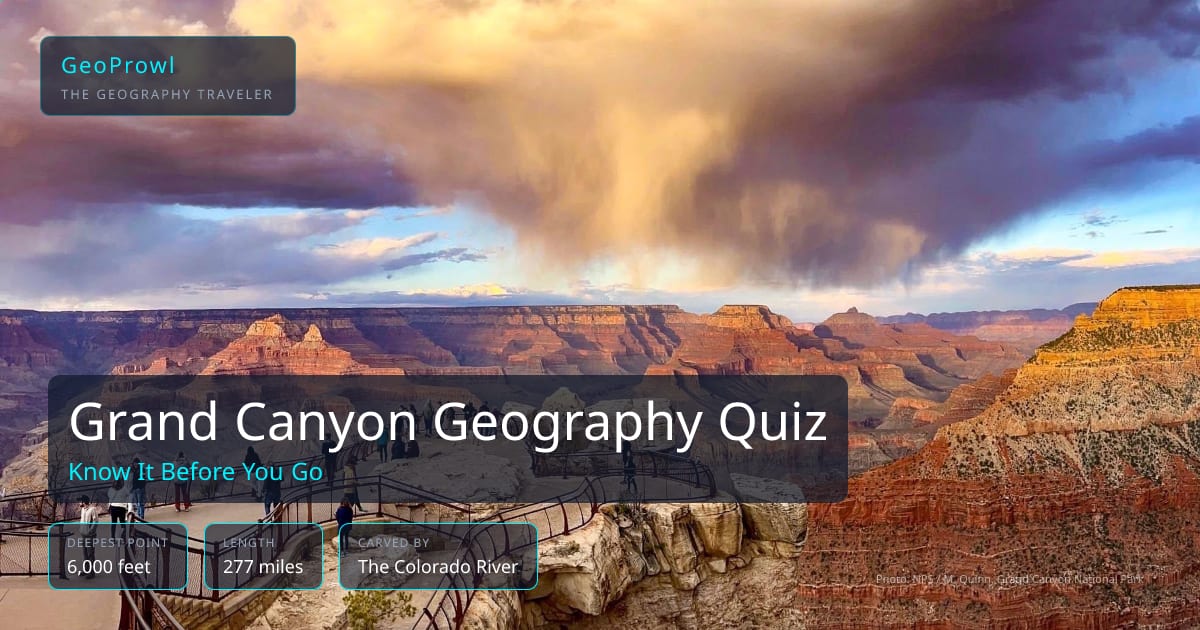
The Quiz
1. What river carved the Grand Canyon?
The Colorado River. The NPS describes the canyon as one of the finest examples of arid-land erosion in the world: the river slowly cutting down through rock over an immense span of time.
2. How deep is the Grand Canyon at its deepest point?
About 6,000 feet, more than a mile straight down.
3. What is the canyon's average depth across its length?
Around 4,000 feet, averaged over its full 277-mile length. The deepest point (6,000 ft) is well above that average.
4. How long is the Grand Canyon?
277 miles.
5. How wide does it get at its widest point?
18 miles across at the widest point.
6. What US state is Grand Canyon National Park in?
Arizona. The park sits on the Colorado Plateau in the northwestern part of the state.
7. How many acres does Grand Canyon National Park cover?
1,218,375 acres.
8. How many of North America's climate zones show up inside the canyon?
Five of North America's seven life zones are represented within the canyon. The NPS compares the range of conditions to "traveling from Mexico to Canada" without leaving the park.
9. How many bird species have been documented in the park?
355 bird species, alongside 89 mammal, 47 reptile, 9 amphibian, and 17 fish species.
10. What does the canyon's rock record show, geologically?
An excellent record of three of the four eras of geologic time, plus a rich and diverse fossil record, which is why the canyon walls are often described as a layered timeline you can walk down into.
Why the Life Zones Matter Most
Of everything on this list, the life-zones fact (question 8) is the one worth dwelling on at the rim. Standing at one overlook, you're looking at desert scrub near the river and conifer forest near the highest points, climate conditions that would normally be separated by thousands of miles of latitude, compressed into one mile of vertical drop. That's not a coincidence of the canyon being pretty; it's the direct, visible result of elevation change, and it's the same idea we cover in more depth in why geographic literacy changes what kids notice on a trip.
Keep Testing Yourself
For the real version of this quiz (no multiple choice, just a photo), try Recon Photos, which uses real National Park Service imagery from Arizona and every other state. Or test your family on 40 more national parks trivia questions before your next trip. Deciding between the Grand Canyon and somewhere else? See the full 7-park comparison guide with a matchmaker quiz. For more like this quiz, browse the full Geography Trivia Questions and Answers hub, organized by difficulty and theme. And if a fourth grader is coming along, don't pay the entrance fee twice, they may already qualify for a free Every Kid Outdoors pass.