March 23, 2026
The Physics of Honey: Why It Pours Slowly and Never Spoils
You have watched honey crawl off a spoon in slow motion. You have noticed it pours faster on a hot day. And if you have ever read about ancient Egypt, you have heard the claim that archaeologists found edible honey in 3,000-year-old tombs. All of these observations point to the same thing: honey is a physically and chemically unusual substance that behaves unlike almost any other food in your kitchen. Here is the science behind the pour, the preservation, and — just for fun — what happens when you fling it.
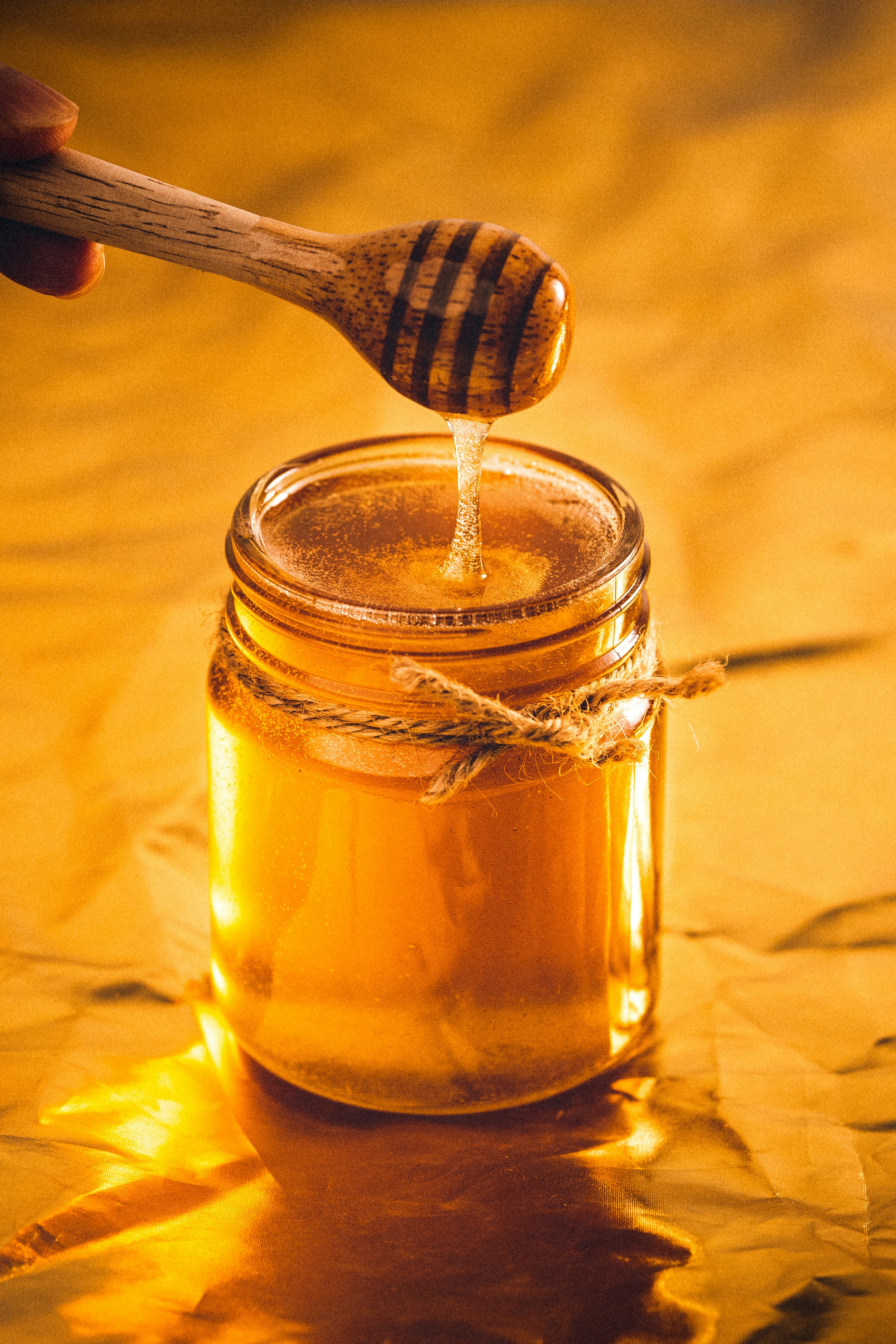
Photo credit: Unsplash
Viscosity: 2,000 to 10,000 Times Thicker Than Water
Viscosity measures a fluid's resistance to flow. Water at room temperature has a viscosity of about 1 centipoise (cP). Honey, depending on its moisture content, temperature, and floral source, ranges from 2,000 to 10,000 centipoise at the same temperature. For comparison, motor oil sits around 100 to 400 cP, and ketchup is roughly 50,000 to 100,000 cP (though ketchup is a non-Newtonian fluid that thins under shear stress, which is why you smack the bottle).
Honey is what physicists call a Newtonian fluid — its viscosity does not change based on how hard you stir or pour it. Apply more force and it flows proportionally faster, but it never suddenly "breaks" into a thinner state the way ketchup or yogurt does. This is why honey drizzles in that smooth, continuous thread rather than splattering or plopping.
The extreme viscosity comes from honey's composition. It is a supersaturated sugar solution — about 82% sugars (primarily fructose and glucose) dissolved in only 17% water. At room temperature, this concentration is actually higher than what water can normally dissolve, which is why honey tends to crystallize over time. The sugar molecules interact through hydrogen bonds, creating internal friction that resists flow. More sugar, less water, higher viscosity.
Temperature Effects: Why Bees Keep It at 95°F
Honey's viscosity is extremely sensitive to temperature. At 70°F (21°C), typical honey has a viscosity around 10,000 cP. Heat it to 100°F (38°C) and it drops to roughly 2,000 cP — a five-fold decrease from just a 30-degree temperature change. At 150°F, it flows almost like warm maple syrup. This dramatic temperature sensitivity follows an exponential relationship described by the Arrhenius equation, not a linear one.
Bees exploit this physics deliberately. The brood nest is maintained at precisely 95°F (35°C), which also happens to be the temperature at which honey is fluid enough for bees to manipulate easily — thin enough to transfer between mouths, spread into cells, and cap with wax, but thick enough not to run out of open comb. If the hive were ten degrees cooler, honey processing would take significantly longer. If ten degrees warmer, honey would be too thin to stay in uncapped cells. The thermal precision is not just about brood development — it is about maintaining the ideal working viscosity of their food supply.
This is why honey crystallizes faster in your pantry than in the hive. At typical kitchen temperatures of 65–72°F, the supersaturated sugars are more likely to precipitate out of solution. Warming crystallized honey in a water bath at 95–100°F — hive temperature — returns it to a liquid state without damaging the enzymes or flavor compounds.
Projectile Physics With a Viscous Blob
What happens when you launch honey through the air? The same Newtonian physics that govern a thrown baseball apply, but with significant modifications from air resistance and the blob's deformable shape. A sphere of honey launched at a 45-degree angle would follow a parabolic trajectory in a vacuum, but in atmosphere, the high surface-area-to-mass ratio of a deforming blob creates substantially more drag than a solid projectile of the same mass.
Honey's density is approximately 1.42 grams per cubic centimeter — about 42% denser than water and significantly denser than most food products. This means a tablespoon of honey (about 21 grams) actually has more mass than a tablespoon of peanut butter or jam. In projectile terms, that density helps: a denser blob maintains more momentum against air resistance.
The real complexity is in the deformation. Unlike a rigid ball, a honey blob stretches, oscillates, and may break into smaller droplets mid-flight depending on the Weber number — a dimensionless ratio of inertial force to surface tension. At low launch speeds, honey's high viscosity and surface tension keep the blob intact. At higher speeds, the blob elongates into a teardrop, then a filament, and eventually fragments. The physics of this breakup are governed by the same Rayleigh–Plateau instability that causes a thin stream of water to break into droplets — except honey's viscosity delays the breakup dramatically, which is why a honey thread can stretch remarkably far before snapping.
3,000 Years and Still Edible
The claim about ancient Egyptian tomb honey is real, and the explanation is straightforward chemistry. Honey resists spoilage through multiple overlapping mechanisms, each of which would be partially effective alone but which together create near-permanent preservation.
First, low moisture content (typically 17–18%) creates an environment too dry for most bacteria and fungi to grow. The USDA grades honey partly on moisture: Grade A requires no more than 18.6% moisture. Above 20%, honey becomes susceptible to fermentation by osmophilic yeasts. Below 18%, almost nothing can grow.
Second, honey is acidic. Its pH averages around 3.9, comparable to orange juice or beer. This acidity is hostile to most bacterial species, including common food pathogens like E. coli and Salmonella. The acid comes primarily from gluconic acid, produced when the bee enzyme glucose oxidase breaks down glucose.
Third, that same glucose oxidase reaction produces trace amounts of hydrogen peroxide — a mild antiseptic. The concentration is too low to taste but enough to inhibit microbial growth. Additionally, honey's high sugar concentration creates osmotic stress that draws water out of bacterial cells, effectively desiccating any microorganism that tries to colonize it. Together, these factors explain why properly sealed honey does not spoil — not in a year, not in a century, and apparently not in three millennia.
Composition by the Numbers
According to USDA FoodData Central, the average composition of honey breaks down as follows: 82.4% sugars (roughly 38% fructose, 31% glucose, 7% maltose, and the rest in trace sugars), 17.1% water, and about 0.5% proteins, vitamins, minerals, and enzymes. The caloric content is approximately 304 calories per 100 grams, or about 64 calories per tablespoon.
The fructose-to-glucose ratio varies by floral source and determines how quickly honey crystallizes. Honeys with higher glucose content — like clover and canola — crystallize faster because glucose is less soluble than fructose. Acacia and tupelo honeys, which are fructose-dominant, can remain liquid for years. This ratio also affects perceived sweetness: fructose tastes about 1.7 times sweeter than glucose, so a high-fructose honey like tupelo tastes sweeter per calorie than a glucose-heavy clover honey.
The USDA NASS Honey Report tracks prices by color grade, and there is a clear market premium for lighter varieties. In 2023, water white honey averaged $3.35 per pound wholesale, while amber averaged $2.15 per pound. Lighter honey generally comes from milder-flavored flower sources like clover and acacia, while darker honey comes from buckwheat, avocado blossoms, or forest honeydew. Ironically, darker honeys typically contain higher concentrations of antioxidants and minerals — they are nutritionally richer but command lower prices because consumer preference skews toward mild, light-colored honey.
Put Honey Physics to the Test
In Honey Fling, you launch blobs of honey at targets using real projectile physics — adjusted for viscosity, density, temperature, and drag. Warmer honey travels differently than cold honey. Denser floral varieties behave differently than light ones. Every shot is a physics problem dressed up as a game. See how far your intuition for fluid dynamics actually goes.
Sources
- USDA FoodData Central, "Honey" nutrient profile (NDB 19296), 2024. Composition breakdown: sugars, moisture, calories, minerals.
- USDA National Agricultural Statistics Service, "Honey" report, March 2024. Price by color grade, production volumes, moisture grading standards.
- National Honey Board, "Honey Varietals Guide," 2023. Crystallization rates by floral source, fructose-glucose ratios.
- Bogdanov, S., "Honey Composition," in The Honey Book, Bee Product Science, 2016. Viscosity measurements, pH, hydrogen peroxide production, and preservation chemistry.