March 19, 2026
What Would Happen If All the Bees Disappeared?
The quote attributed to Einstein — "If the bee disappeared off the surface of the Earth, man would have no more than four years to live" — is almost certainly something Einstein never said. But the spirit of the warning isn't entirely wrong. Bees pollinate a staggering portion of the food we eat, and their loss would trigger cascading failures across agriculture, wild ecosystems, and the global economy. The question isn't whether it would be bad. The question is how bad, and where the dominoes would fall first.
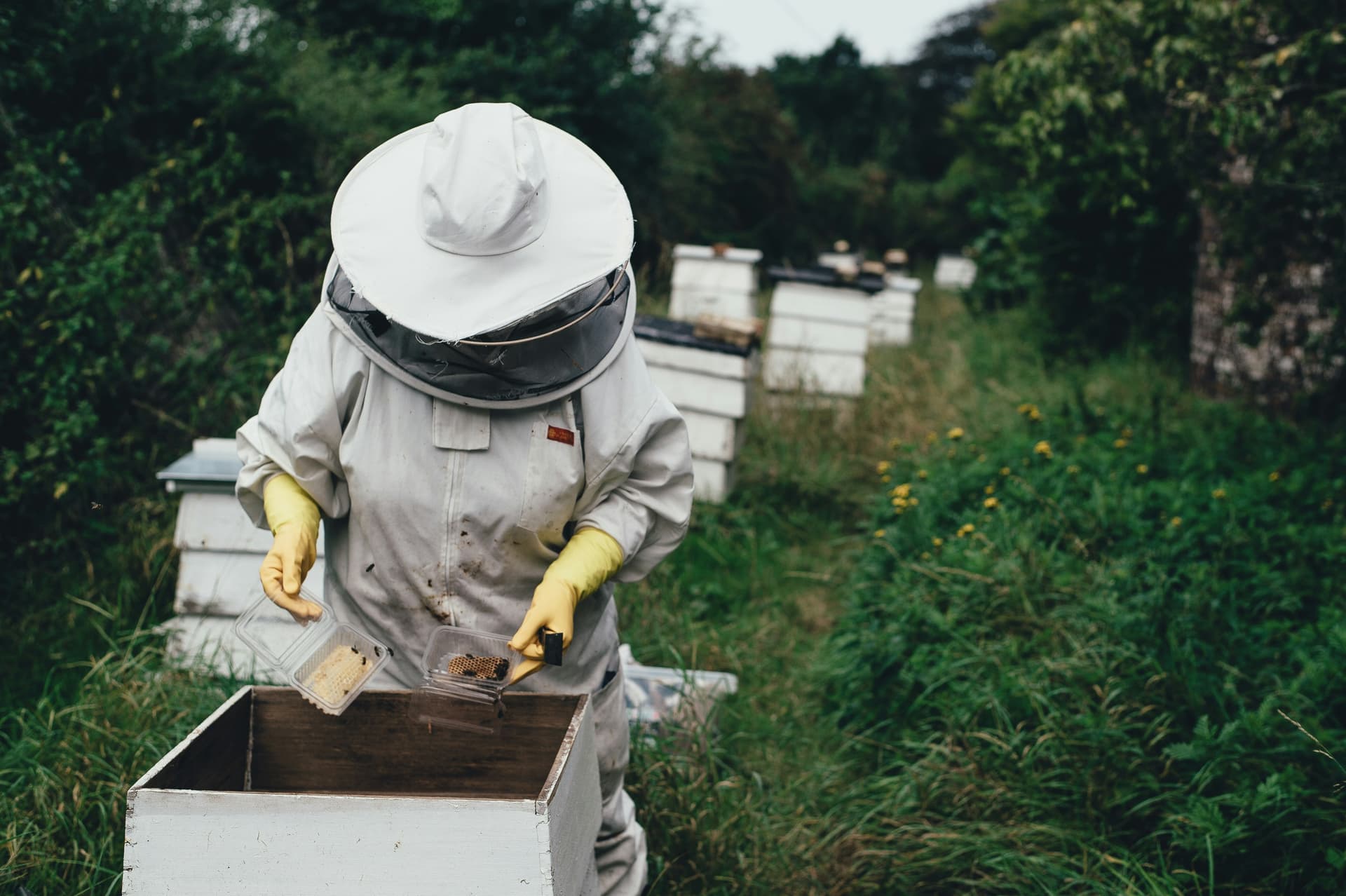
Photo credit: Unsplash
A Grocery Store Without Bees
Walk through a typical American supermarket and start removing everything that depends on bee pollination. The produce section is hit first and hardest. Apples, almonds, blueberries, cherries, avocados, cucumbers, onions, and dozens of other fruits and vegetables require insect pollination to produce viable crops. The USDA Economic Research Service estimates that insect-pollinated crops account for more than $18 billion in annual US agricultural value. Globally, that figure exceeds $235 billion.
California's almond industry provides the starkest example of dependence. Almonds are 100 percent dependent on honeybee pollination — without bees, there are no almonds. The crop is worth roughly $6 billion annually and requires approximately 2 million managed honeybee colonies — about 75 percent of all commercial colonies in the country — to be trucked to California's Central Valley each February. If those bees vanished, the entire almond crop would fail within a single season.
But it's not just the crops we eat directly. Alfalfa, a major livestock feed crop, depends on bee pollination. Without pollinated alfalfa, dairy and beef production costs would spike. Clover, another pollinator-dependent forage crop, underpins pasture-based livestock operations across the Midwest and Southeast. The secondary effects ripple through the food system far beyond the produce aisle — into dairy, meat, and even processed foods that contain bee-pollinated ingredients like soybean oil, sunflower lecithin, or fruit-based sweeteners.
4,000 Species You've Never Heard Of
When most people hear "bees," they picture the European honeybee — Apis mellifera — the species managed by beekeepers. But honeybees are just one species out of roughly 20,000 bee species worldwide. The United States alone is home to approximately 4,000 native bee species, as documented by the USGS Native Bee Inventory and Monitoring Lab.
These native species are wildly diverse. Bumblebees are the most recognizable — large, fuzzy, social insects that nest underground and are among the few bee species active in cold, rainy, and overcast conditions. Mason bees are solitary cavity nesters that are exceptionally efficient pollinators of fruit trees — a single mason bee can do the pollination work of 60 to 100 honeybees on apple blossoms, because they carry pollen loosely on their bellies rather than packed in tight corbiculae on their legs. Sweat bees, mining bees, leafcutter bees, carpenter bees — each occupies a specific ecological niche and pollinates specific plants.
The Xerces Society for Invertebrate Conservation has identified numerous native bee species in decline across North America. The American bumble bee (Bombus pensylvanicus) has disappeared from much of its former range. The western bumble bee (Bombus occidentalis) has declined by more than 90 percent in some regions. These losses matter because native bees pollinate native plants that honeybees often ignore — and those native plant communities are the foundation of wild ecosystems.
The Cascade Effect
If all bees disappeared simultaneously — a hypothetical, but a useful thought experiment — the effects would cascade through ecosystems in waves. The first wave would be agricultural: crop yields for pollinator-dependent species would plummet within a single growing season. Prices for fruits, nuts, and vegetables would spike. Farmers would scramble for alternatives — hand pollination (labor-intensive and expensive), wind-based crops, or robotic pollinators (still experimental).
The second wave would hit wild plant communities. Roughly 85 percent of flowering plant species depend on animal pollinators for reproduction, and bees are the primary pollinators for most of them. Without pollination, these plants wouldn't set seed. Existing plants would continue to live for a while — perennials and trees don't die immediately — but they wouldn't reproduce. Over years, plant diversity would collapse in bee-dependent ecosystems. Meadows would shift toward wind-pollinated grasses. Forest understories would thin as bee-pollinated shrubs and wildflowers failed to regenerate.
The third wave would hit animals that depend on bee-pollinated plants. Songbirds that eat berries and seeds from pollinated plants would lose food sources. Small mammals — mice, chipmunks, squirrels — that eat nuts and fruits would decline. Predators that depend on those prey species would be affected in turn. The cascade doesn't stop at the point where bees touch the food web — it propagates upward through every trophic level. This is what ecologists call a "trophic cascade," and pollinator loss is one of the most plausible triggers for a continental-scale cascade event.
The economic shock would be substantial. The USDA ERS models suggest that complete loss of insect pollination services would reduce US agricultural output by $15 to $20 billion annually in direct crop losses, with additional billions in downstream effects on food processing, livestock feed, and export markets. Globally, the figure could approach $500 billion — enough to destabilize food prices in developing nations that depend on pollinator-reliant crops like coffee, cocoa, and tropical fruits.
Crops That Don't Need Bees
Not everything on your plate requires bee pollination, and understanding which crops are self-sufficient helps calibrate the real risk. The world's staple grain crops — wheat, rice, corn, and barley — are wind-pollinated or self-pollinating. They would continue to produce yields without any insect pollinators. Corn is wind-pollinated (those tassels at the top release pollen that drifts to the silks below). Rice and wheat are largely self-pollinating.
Root vegetables — potatoes, carrots, beets, sweet potatoes — are harvested before they flower, so pollination is irrelevant to the food product (though seed production for future crops does require pollination in some cases). Leafy greens like lettuce, spinach, and kale are also harvested before flowering. Legumes like soybeans and peanuts are primarily self-pollinating, though bee visits can increase yields by 10 to 20 percent.
So humanity wouldn't starve. The caloric foundation of the global food system — grains and root crops — would survive intact. But the diet would be dramatically impoverished. Imagine meals without apples, berries, almonds, chocolate, coffee, avocados, tomatoes, peppers, squash, or melons. The nutritional diversity that prevents deficiency diseases depends heavily on pollinator-reliant fruits and vegetables. A world without bees would be a world with enough calories but far fewer vitamins, minerals, and the variety that makes food worth eating.
The Other Pollinators
Bees are the most important pollinators, but they're not the only ones. A complete picture of pollinator loss requires understanding the full roster of animals that move pollen between flowers — and whether they could compensate if bees disappeared.
Butterflies and moths pollinate many wildflowers and some crops, particularly those with deep, tubular flowers. Hawk moths are the primary pollinators of certain orchid species. Monarch butterflies, while famous for their migration, are relatively minor pollinators compared to bees — their smooth legs don't carry pollen efficiently. Moths are important nighttime pollinators, serving flowers that bloom after dark.
Flies are surprisingly significant pollinators. Hoverflies (family Syrphidae) visit flowers for nectar and incidentally transfer pollen, and they are the second most important group of crop pollinators after bees. Midges pollinate chocolate — Theobroma cacao is primarily pollinated by tiny ceratopogonid midges, not bees. Without these flies, chocolate production would collapse regardless of bee populations.
Hummingbirds pollinate many red and orange tubular flowers across the Americas. Bats are critical pollinators in tropical and desert ecosystems — agave (the source of tequila) is primarily bat-pollinated. Beetles were among the earliest pollinators in evolutionary history and still pollinate magnolias, water lilies, and some tropical fruits. Even wasps and ants contribute incidental pollination, though their role is minor compared to bees.
Could these other pollinators fill the gap if bees vanished? The honest answer is: partially, but not fully. Bees are uniquely adapted for pollination — their branched body hairs trap pollen efficiently, they visit flowers systematically, and many species exhibit "flower constancy," visiting the same plant species repeatedly rather than hopping between species. This constancy is what makes bees so effective for agriculture. Other pollinators tend to be generalists or specialists for specific flower types. They provide essential backup but couldn't replace the volume and efficiency of bee pollination across the full range of crops and wild plants that depend on it.
Watch the Dominoes Fall
Pollination isn't just about bees and flowers — it's a web of dependencies that connects insects to plants to animals to the food on your table. In Pollinator Partners, you'll build and manage a pollination network, watching how removing one species sends ripples through the entire system.
Play Pollinator Partners →Sources
- USDA Economic Research Service. "Pollination Services." ers.usda.gov.
- USGS Native Bee Inventory and Monitoring Lab. "Bee Basics: An Introduction to Our Native Bees." usgs.gov.
- Xerces Society for Invertebrate Conservation. "Red List of Bees." xerces.org.
- Klein, A.-M., et al. (2007). "Importance of pollinators in changing landscapes for world crops." Proceedings of the Royal Society B, 274(1608), 303-313.
- USDA National Agricultural Statistics Service. "Noncitrus Fruits and Nuts Summary." nass.usda.gov.
- Gallai, N., et al. (2009). "Economic valuation of the vulnerability of world agriculture confronted with pollinator decline." Ecological Economics, 68(3), 810-821.