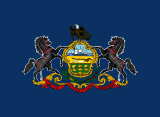
Pennsylvania
PA · Data from 2022–2023 government sources · Northeast · 50 States Learning Path
Pennsylvania, the Keystone State, is where American democracy was born. Philadelphia's Independence Hall saw the signing of both the Declaration of Independence and the Constitution. Beyond its founding-era history, Pennsylvania is a state of industrial grit, natural beauty, and cultural richness — from the steel legacy of Pittsburgh to the rolling farmland of Amish Country to the forested Appalachian Mountains.
Think you know Pennsylvania? Test your geography skills.
History
Pennsylvania was founded by William Penn in 1681 as a Quaker colony based on religious tolerance. Philadelphia served as the nation's capital from 1790 to 1800 and was the site of the Continental Congress. Pennsylvania became the second state to ratify the Constitution in 1787. The Battle of Gettysburg (1863) was the Civil War's turning point. The state's industrial might — steel in Pittsburgh, coal in the anthracite region, oil in Titusville (the world's first commercial oil well, 1859) — powered America's growth into an industrial superpower.
Economy
Pennsylvania has a $900 billion economy driven by healthcare, education, energy, manufacturing, and financial services. Pittsburgh has reinvented itself as a tech and healthcare hub, with Carnegie Mellon University leading in robotics and AI. Philadelphia is a major financial, healthcare, and pharmaceutical center. Pennsylvania is the second-largest natural gas producing state (Marcellus Shale). Agriculture includes dairy (Pennsylvania ranks among the top dairy states), mushrooms (60% of the nation's supply), and apples.
Geography & Landmarks
Pennsylvania covers 46,054 square miles of varied terrain. The Appalachian Mountains run diagonally through the state, with the Ridge and Valley province in the center and the Allegheny Plateau in the west. The Delaware River forms the eastern border. The Pocono Mountains are a popular resort area. Pennsylvania's 'Grand Canyon' — the Pine Creek Gorge — stretches 47 miles through north-central Pennsylvania. The state has 121 state parks. The Pocono Mountains in northeastern Pennsylvania cover approximately 2,400 square miles of forested ridges, lakes, and waterfalls. The Susquehanna River, the longest river on the American East Coast at 444 miles, drains nearly half of Pennsylvania and flows through dramatic water gaps carved through Appalachian ridges.

Carlisle Federal Indian Boarding School National Monument — US Army/Dickinson College
Source: NPS API
Culture & Traditions
Pennsylvania's cultural contributions are foundational to the American experience. Philadelphia's music scene produced The Sound of Philadelphia (TSOP), the lush soul sound created by Kenneth Gamble and Leon Huff that dominated 1970s R&B, and the city's hip-hop legacy includes The Roots, DJ Jazzy Jeff, and Meek Mill. The Philadelphia cheesesteak, born at Pat's King of Steaks in 1930, and the soft pretzel are street food staples, while Pittsburgh's culinary signature is the Primanti Brothers sandwich (with french fries and coleslaw piled inside). The Philadelphia Museum of Art, home to over 240,000 objects, is the third-largest art museum in the country, and Pittsburgh's Andy Warhol Museum is the largest museum dedicated to a single artist in North America. Pennsylvania's sports culture is intense, with the Steelers' Terrible Towel tradition, the Eagles' famously passionate fanbase, and Penn State's Beaver Stadium creating a White Out atmosphere for over 106,000 fans.
Notable Cities
Harrisburg
CapitalThe state capital on the Susquehanna River. The Pennsylvania State Capitol building, with its Renaissance dome modeled after St. Peter's Basilica, was called 'the handsomest building I ever saw' by Theodore Roosevelt.
50,055
Population
$46,654
Median income
$112,100
Home value
$944
Median rent
31.9
Median age
9.0%
Unemployment
35.5%
Homeownership
4,692
Bachelor's+
Philadelphia
The birthplace of American democracy. Home to Independence Hall, the Liberty Bell, a world-class art museum, and the cheesesteak. The sixth-largest city in the U.S.
Pittsburgh
The Steel City reinvented. Where three rivers meet, Pittsburgh has transformed from an industrial powerhouse into a leader in technology, healthcare, and education.
Gettysburg
Site of the Civil War's most famous battle and Lincoln's Gettysburg Address. The battlefield is one of the most visited historic sites in the United States.
Lancaster
The heart of Pennsylvania Dutch Country and home to the largest Amish community in the world. A blend of traditional farming culture and a growing food and arts scene.
Capital city data: Census Bureau ACS 5-Year (2022)
Intel File · Fun Facts
The first computer (ENIAC), the first commercial radio station (KDKA), and the first Zippo lighter were all created in Pennsylvania.
Hershey, Pennsylvania is the Chocolate Capital of the World — even the streetlights are shaped like Hershey's Kisses.
Pennsylvania produces about 60% of the mushrooms grown in the United States, concentrated in Chester County.
The first World Series was played in Pittsburgh in 1903.
Punxsutawney Phil, the famous groundhog, has been predicting the arrival of spring from Gobbler's Knob since 1887.
Printable Worksheet
Free, GeoProwl-branded, classroom-ready.
Download the Pennsylvania Worksheet (PDF)
One page · ready to print at home or in class
Nickname
The Keystone State
Motto
Virtue, Liberty, and Independence
State Bird
Ruffed Grouse
State Flower
Mountain Laurel
State Tree
Eastern Hemlock
Also included: fill in what you learned
1. The first computer (ENIAC), the first commercial radio station (KDKA), and the first Zippo lighter were all created in Pennsylvania.
2. Hershey, Pennsylvania is the Chocolate Capital of the World — even the streetlights are shaped like Hershey's Kisses.
3. Pennsylvania produces about 60% of the mushrooms grown in the United States, concentrated in Chester County.
4. The first World Series was played in Pittsburgh in 1903.
Want all 50 states?
One PDF packet, every state, ready to print for the whole class.
Pair it with a math worksheet
Four Fours Challenge: build every number 1–100 using exactly four 4s.
Data & Statistics
Demographics
- Population
- 12,989,208
- Median income
- $73,170
- Median age
- 40.8
- Median home value
- $226,200
- Below poverty line
- 1,482,439
- Bachelor's degree+
- 1,844,355
Source: U.S. Census Bureau, ACS 5-Year Estimates (2022)
Agriculture
- Total farms
- 49,053
- Cropland
- 4,431,311 acres
- Market value
- $10,282M
Source: USDA NASS, Census of Agriculture (2022)
Public Health
- Obesity rate
- 33.4%
- Diabetes rate
- 11.5%
- Smoking rate
- 14.9%
- High blood pressure
- N/A
- Uninsured
- N/A
Source: CDC BRFSS Prevalence Data (2023, 2022 fallback)
National Parks & Sites
- National parks
- 0
- Total NPS sites
- 26
- Sites
- Allegheny Portage Railroad National Historic Site, Appalachian National Scenic Trail, Captain John Smith Chesapeake National Historic Trail, Carlisle Federal Indian Boarding School National Monument, Chesapeake Bay, Delaware Water Gap National Recreation Area, Edgar Allan Poe National Historic Site, Eisenhower National Historic Site, First State National Historical Park, Flight 93 National Memorial, Fort Necessity National Battlefield, Friendship Hill National Historic Site, Gettysburg National Military Park, Gloria Dei Church National Historic Site, Hopewell Furnace National Historic Site, Independence National Historical Park, Johnstown Flood National Memorial, Lewis & Clark National Historic Trail, Lower Delaware National Wild and Scenic River, North Country National Scenic Trail, Potomac Heritage National Scenic Trail, Steamtown National Historic Site, Thaddeus Kosciuszko National Memorial, Upper Delaware Scenic & Recreational River, Valley Forge National Historical Park, Washington-Rochambeau Revolutionary Route National Historic Trail
Source: National Park Service API
Climate
- Avg temperature
- 49.8°F
- Avg high
- 60.6°F
- Avg low
- 39.2°F
- Annual precipitation
- 43.1 in
- Annual snowfall
- 35.4 in
Source: NOAA Climate Normals (2010)
Frequently Asked Questions
What is the capital of Pennsylvania?▾
Harrisburg is the capital of Pennsylvania — not Philadelphia or Pittsburgh. It has been the state capital since 1812 and is located on the Susquehanna River in south-central Pennsylvania.
Why is Pennsylvania called the Keystone State?▾
Pennsylvania is called the Keystone State because of its central geographic position among the original 13 colonies (the 'keystone' of the colonial arch) and its key role in the nation's founding — the Declaration of Independence and Constitution were both signed in Philadelphia.
What is the Amish Country?▾
Pennsylvania's Amish Country, centered in Lancaster County, is home to the largest Amish community in the world (about 40,000 people). The Amish live a traditional lifestyle without most modern technology, traveling by horse and buggy. The area is popular for farm tours, handmade crafts, and traditional Pennsylvania Dutch food.
What happened at Gettysburg?▾
The Battle of Gettysburg (July 1-3, 1863) was the bloodiest battle of the Civil War, with over 50,000 casualties. The Union victory was a turning point in the war. President Lincoln's Gettysburg Address, delivered at the battlefield's dedication, is one of the most famous speeches in American history.
Data sources
U.S. Census Bureau · USDA NASS · CDC BRFSS · National Park Service · NOAA CDO
This product uses the Census Bureau Data API but is not endorsed or certified by the Census Bureau. This product uses the NASS API but is not endorsed or certified by NASS.
Test your knowledge →
Play today's GeoProwl daily challenge — 10 states, 3 clues each, powered by real data.