
South Carolina
SC · Data from 2022–2023 government sources · Southeast · 50 States Learning Path
South Carolina, the Palmetto State, is a Southern state steeped in history and natural beauty. Charleston, consistently ranked among the world's best cities, blends antebellum architecture with a modern culinary renaissance. From the Blue Ridge Mountains to the Lowcountry marshes and barrier islands, South Carolina offers diverse landscapes and a culture shaped by centuries of complex history.
Think you know South Carolina? Test your geography skills.
History
South Carolina was one of the original 13 colonies, founded in 1663. Charleston was one of the wealthiest cities in colonial America, its prosperity built on rice, indigo, and enslaved labor. South Carolina was the first state to secede from the Union in December 1860, and the Civil War began with the bombardment of Fort Sumter in Charleston Harbor in April 1861. The Gullah Geechee culture, descended from enslaved West Africans, survives along the Sea Islands and Lowcountry coast.
Economy
South Carolina's economy has diversified from its textile and agricultural roots. The state is a major manufacturing hub — BMW's only U.S. plant is in Spartanburg (the largest BMW factory in the world by volume), and Boeing assembles 787 Dreamliners in North Charleston. Tourism, particularly in Charleston and Myrtle Beach, generates over $24 billion annually. Agriculture includes peaches (SC ranks second nationally), tobacco, and poultry. The military has a significant presence with Fort Jackson and Joint Base Charleston.
Geography & Landmarks
South Carolina covers 32,020 square miles, ranging from the Blue Ridge Mountains in the northwest corner to the Atlantic coastal plain. The Lowcountry — a region of tidal marshes, barrier islands, and live oak forests draped in Spanish moss — is one of the most distinctive landscapes in the Southeast. The ACE Basin (Ashepoo, Combahee, Edisto rivers) is one of the largest undeveloped estuaries on the East Coast. Hilton Head Island and Kiawah Island are world-renowned resort destinations. The ACE Basin encompasses approximately 350,000 acres of wetlands, maritime forests, and barrier islands. Table Rock State Park in the Blue Ridge foothills features a dramatic granite face rising 3,124 feet, a remnant of the ancient Appalachian range.
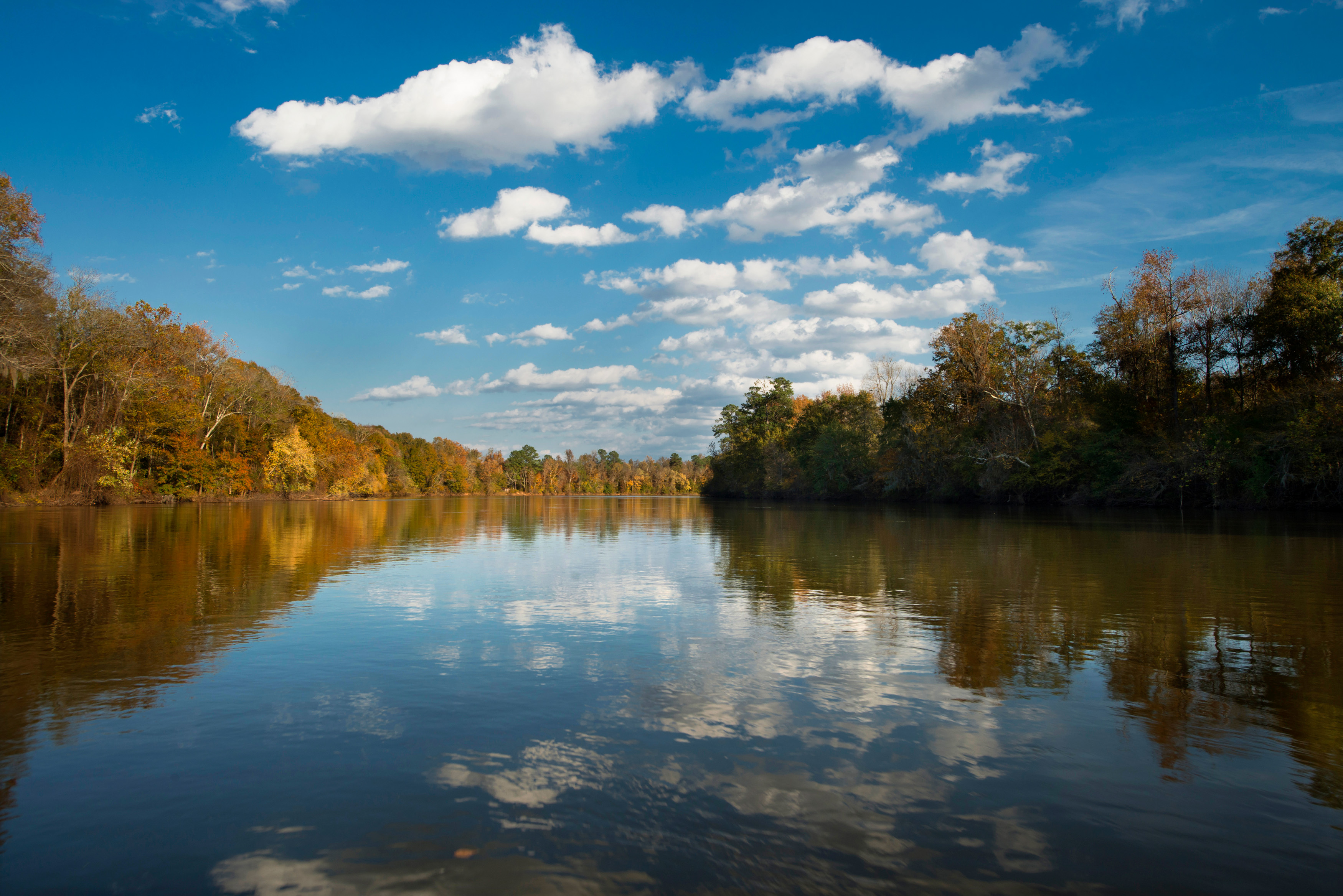
Congaree National Park — NPS
Source: NPS API
Culture & Traditions
South Carolina's cultural heritage runs deep, from the Gullah-Geechee traditions of the Lowcountry Sea Islands to the state's pivotal role in American history and arts. The Gullah culture, descended from West African enslaved peoples, preserves distinct language, basket-weaving artistry (sweetgrass baskets sold in Charleston's City Market), cuisine, and spiritual traditions. Charleston's culinary scene has become one of the most celebrated in the country, anchored by Lowcountry staples like shrimp and grits, she-crab soup, and Frogmore stew (Lowcountry boil). The Spoleto Festival USA in Charleston, founded in 1977, is one of America's premier performing arts festivals, presenting opera, theater, dance, and music over 17 days each May and June. The University of South Carolina Gamecocks and Clemson Tigers maintain one of the most heated rivalries in all of college sports, and the Heritage Golf Tournament on Hilton Head Island is a PGA Tour fixture.
Notable Cities
Columbia
CapitalThe state capital and largest city, home to the University of South Carolina. Located at the confluence of the Broad and Saluda Rivers in the geographic center of the state.
136,754
Population
$54,095
Median income
$226,200
Home value
$1,105
Median rent
28.3
Median age
7.1%
Unemployment
47.0%
Homeownership
19,025
Bachelor's+
Charleston
One of America's most charming cities, known for its pastel-colored historic homes, world-class restaurants, Fort Sumter, and warm Southern hospitality.
Myrtle Beach
The heart of the Grand Strand, a 60-mile stretch of Atlantic coastline. One of the most visited tourist destinations on the East Coast.
Greenville
A revitalized upstate city with a stunning downtown centered on Falls Park on the Reedy. One of the fastest-growing cities in the Southeast.
Beaufort
A charming Lowcountry town on Port Royal Island, known for its antebellum architecture, Gullah culture, and proximity to Parris Island Marine Corps Recruit Depot.
Capital city data: Census Bureau ACS 5-Year (2022)
Intel File · Fun Facts
The Civil War began in South Carolina when Confederate forces fired on Fort Sumter in Charleston Harbor on April 12, 1861.
South Carolina produces more peaches than Georgia (the 'Peach State') — SC ranks second nationally behind California.
BMW's Spartanburg plant is the largest BMW factory in the world by volume, producing over 400,000 vehicles per year.
Charleston's restaurant scene has earned it multiple James Beard Awards, making it one of the top food cities in America.
The Angel Oak on Johns Island near Charleston is estimated to be 400-500 years old, with a canopy covering 17,200 square feet.
Printable Worksheet
Free, GeoProwl-branded, classroom-ready.
Download the South Carolina Worksheet (PDF)
One page · ready to print at home or in class
Nickname
The Palmetto State
Motto
Dum Spiro Spero (While I Breathe, I Hope)
State Bird
Carolina Wren
State Flower
Yellow Jessamine
State Tree
Sabal Palmetto
Also included: fill in what you learned
1. The Civil War began in South Carolina when Confederate forces fired on Fort Sumter in Charleston Harbor on April 12, 1861.
2. South Carolina produces more peaches than Georgia (the 'Peach State') — SC ranks second nationally behind California.
3. BMW's Spartanburg plant is the largest BMW factory in the world by volume, producing over 400,000 vehicles per year.
4. Charleston's restaurant scene has earned it multiple James Beard Awards, making it one of the top food cities in America.
Want all 50 states?
One PDF packet, every state, ready to print for the whole class.
Pair it with a math worksheet
Four Fours Challenge: build every number 1–100 using exactly four 4s.
Data & Statistics
Demographics
- Population
- 5,142,750
- Median income
- $63,623
- Median age
- 40.0
- Median home value
- $216,200
- Below poverty line
- 717,849
- Bachelor's degree+
- 674,340
Source: U.S. Census Bureau, ACS 5-Year Estimates (2022)
Agriculture
- Total farms
- 22,633
- Cropland
- 1,950,175 acres
- Market value
- $4,427M
Source: USDA NASS, Census of Agriculture (2022)
Public Health
- Obesity rate
- 36.0%
- Diabetes rate
- 14.9%
- Smoking rate
- 12.1%
- High blood pressure
- 38.8%
- Uninsured
- 10.0%
Source: CDC BRFSS Prevalence Data (2023, 2022 fallback)
National Parks & Sites
- National parks
- 1
- Total NPS sites
- 8
- Sites
- Charles Pinckney National Historic Site, Congaree National Park, Cowpens National Battlefield, Fort Sumter and Fort Moultrie National Historical Park, Kings Mountain National Military Park, Ninety Six National Historic Site, Overmountain Victory National Historic Trail, Reconstruction Era National Historical Park
Source: National Park Service API
Climate
- Avg temperature
- 62.6°F
- Avg high
- 74.2°F
- Avg low
- 50.8°F
- Annual precipitation
- 46.9 in
- Annual snowfall
- 0.7 in
Source: NOAA Climate Normals (2010)
Frequently Asked Questions
What is the capital of South Carolina?▾
Columbia is the capital of South Carolina. Located in the center of the state, it has been the capital since 1786.
Why is Charleston so popular?▾
Charleston is consistently voted one of the best cities in the world for its remarkably preserved historic district, world-class dining (led by chefs like Sean Brock), beautiful beaches, and warm Southern culture. The city has over 350 years of history visible in its architecture and traditions.
What is the Lowcountry?▾
The Lowcountry is the coastal region of South Carolina (and parts of Georgia), characterized by tidal marshes, barrier islands, live oak trees draped in Spanish moss, and a unique culture influenced by Gullah Geechee traditions. It includes Charleston, Beaufort, Hilton Head, and the Sea Islands.
What is Gullah Geechee culture?▾
Gullah Geechee is the culture of African Americans living along the Southeast coast from North Carolina to Florida. Descended from enslaved West and Central Africans, the Gullah people preserved African languages, foodways, crafts (especially sweetgrass basketry), and traditions. The Gullah Geechee Cultural Heritage Corridor was established by Congress in 2006.
Data sources
U.S. Census Bureau · USDA NASS · CDC BRFSS · National Park Service · NOAA CDO
This product uses the Census Bureau Data API but is not endorsed or certified by the Census Bureau. This product uses the NASS API but is not endorsed or certified by NASS.
Test your knowledge →
Play today's GeoProwl daily challenge — 10 states, 3 clues each, powered by real data.