Cross-curricular unit plan · Grade 3 · 4 weeks
A Grade 3 Cross-Curricular STEM Unit Plan: States, Stories, and the Scale of Things
A complete classroom- and homeschool-ready unit plan built as a bridge between Grade 2 and Grade 4. Students leave the unit comfortable multiplying within 100, able to locate all fifty US states on a map, and able to name the eight planets in order from the Sun — using real government data throughout instead of made-up numbers. NGSS + Common Core aligned, with daily activities, assessments, and differentiation guidance.
1. At-a-glance
- Grade level
- Grade 3 (also useful for advanced Grade 2 or a Grade 4 review week)
- Duration
- 4 weeks · 5 sessions/week · 25–35 minutes per session
- Audience
- Classroom teachers and homeschool parents
- Subjects integrated
- Math, US geography, Earth/space science, reading & writing
- Primary GeoProwl sections used
- Figure It Out, GeoZone, Solar System
- Culminating project
- One-page “My State Postcard” using site data
2. Standards alignment
Every activity in this unit is anchored in a published standard, with one exception noted below. Where multiple standards apply we list the most central one.
| Code | Description | Unit connection |
|---|---|---|
CCSS.3.OA.A.1 | Interpret products of whole numbers, e.g. 5 × 7 as the total number of objects in 5 groups of 7 objects each. | Ratio Kitchen Easy tier — doubling and tripling a recipe. |
CCSS.3.OA.A.3 | Use multiplication and division within 100 to solve word problems in situations involving equal groups, arrays, and measurement quantities. | Ratio Kitchen scaling problems; state-data comparison sentences in week 2. |
CCSS.3.NBT.A.2 | Fluently add and subtract within 1000 using strategies based on place value. | Comparing two states' park counts or city counts during the data hunt. |
CCSS.3.MD.B.3 | Draw a scaled picture graph and a scaled bar graph to represent a data set with several categories. | Class bar chart of National Park sites per state, built from Fast Facts data. |
CCSS.RI.3.1 | Ask and answer questions to demonstrate understanding of a text, referring explicitly to the text as the basis for the answers. | Reading a state's Fast Facts page to pull the data points for the postcard project. |
CCSS.W.3.7 | Conduct short research projects that build knowledge about a topic. | Culminating My State Postcard project. |
NGSS 5-ESS1-1 | Support an argument that differences in the apparent brightness of the sun compared to other stars is due to their relative distances from Earth. | Early exposure only — Planet ID and Scale Detective introduce planet order and relative size, not the full argument. This is a Grade 5 standard; treat week 3 as enrichment, not assessed mastery. |
C3.D2.Geo.2.3-5 | Use maps, globes, and other simple geographic tools to identify cultural and environmental characteristics of places. | Just States, Just Capitals, and the Recon Photos game. |
3. Unit structure and daily activities
The sequence mirrors the Grade 4 unit's logic at a gentler pace: multiplication first, then geography, then an early look at the solar system, then a short synthesis project. Each session runs a 5-minute warmup, 15–20 minutes of core activity, and 5 minutes of reflection. Sessions are shorter than the Grade 4 unit's — third graders hold focus best in that window.
Week 1 — Multiplication and scaling
Goal: every student can double or triple a small whole number confidently by the end of the week. This is the load-bearing skill for the data work in week 2.
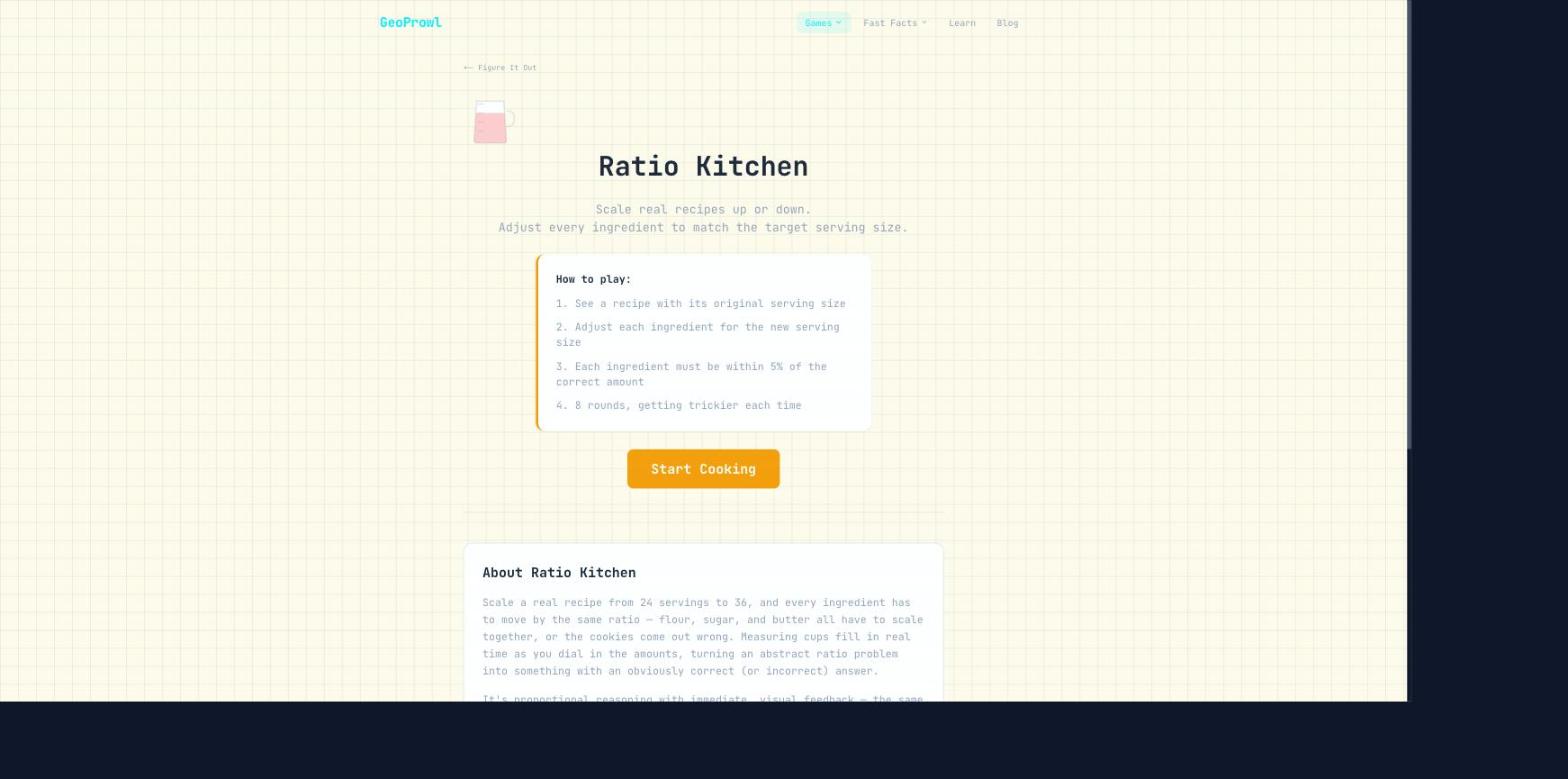
- Day 1 — Diagnostic. Have every student play one Easy round of Ratio Kitchen. Record scores privately. Then teach a 10-minute mini-lesson on what “doubling a recipe” means using real measuring cups if you have them.
- Day 2 — Doubling practice. Students play three Easy rounds of Ratio Kitchen. Exit ticket: if a recipe uses 2 cups of flour for 12 cookies, how much flour for 24 cookies?
- Day 3 — Tripling and beyond. Mini-lesson: skip-counting by the scale factor (if you triple, count by 3s). Students play three more Easy rounds. Exit ticket: triple a recipe that uses 3 eggs.
- Day 4 — Multiplication word problems. Move off-screen for a short worksheet of equal-groups word problems styled after Ratio Kitchen (“the class has 4 tables, 6 students each — how many students total?”). Students who finish early play a bonus Easy round.
- Day 5 — Mastery check. Students play three Easy rounds of Ratio Kitchen independently, aiming for a personal best. Score is the formative checkpoint, not the grade. Class reflection: what's one recipe you'd want to scale up for a party?
Week 2 — US geography and reading real data
Goal: students can name a growing number of states by location and can read one data point off a state's Fast Facts page without help. This week is where CCSS.RI.3.1 lives — every data point comes from reading an actual page, not a worksheet.
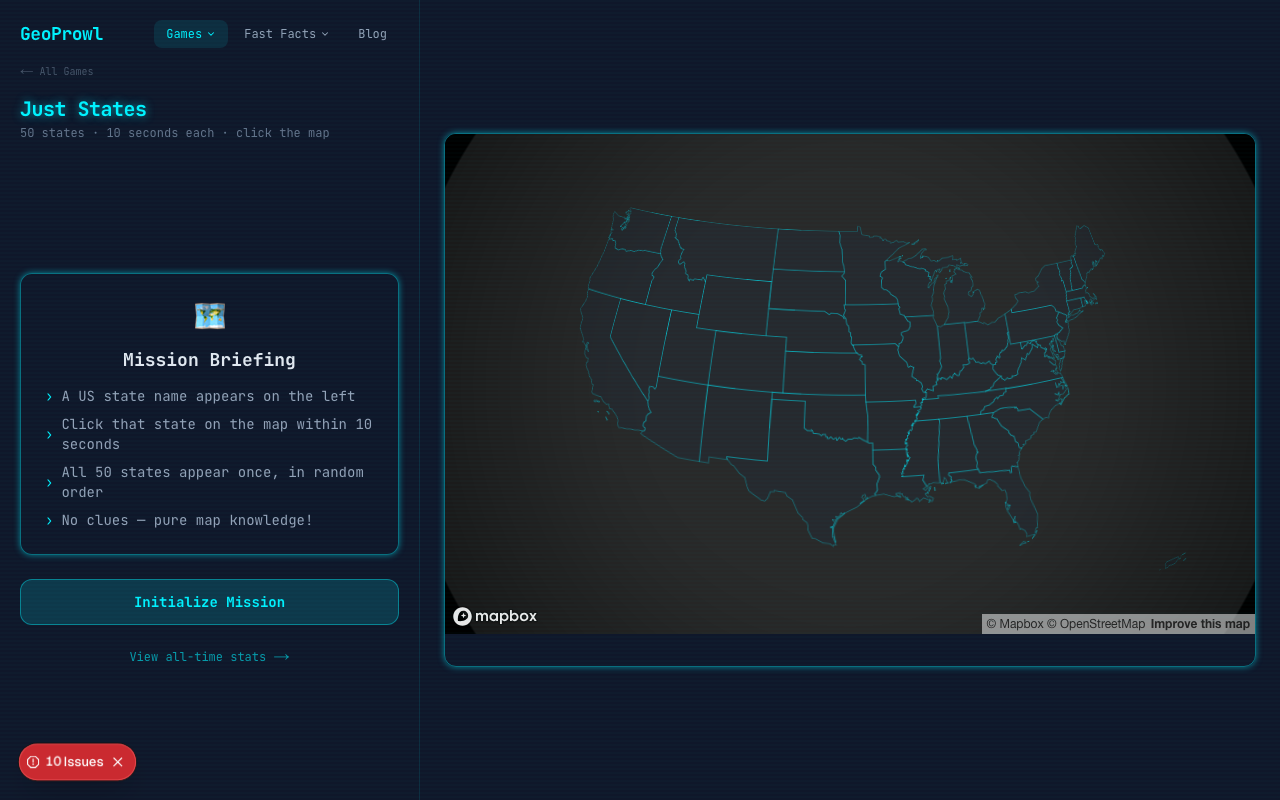
- Day 6 — State recall. Open with Just States. Track first-attempt score as the diagnostic. Reflection: students draw the US map outline from memory and label as many states as they can (five is a fine start).
- Day 7 — Capitals, lightly. Switch to Just Capitals for a shorter round — five capitals is a fine goal. Pair with a two-minute story: capitals aren't always the biggest city in a state (Albany, not New York City).
- Day 8 — Reading for data. Each student picks one state from Fast Facts: States and records two data points: population and number of National Park sites. This is a guided reading exercise — model finding the numbers on the page first.
- Day 9 — Build a class bar graph. As a whole class, plot each student's National Park count on a shared bar graph (CCSS.3.MD.B.3). Discuss: which state has the most? Are any states tied?
- Day 10 — Photos and place. Recon Photos shows real National Park Service photos and asks students to guess the state. Play in pairs — talking through the guess out loud is the point, not getting it right.
Week 3 — An early look at the solar system
Goal: every student can name the 8 planets in order from the Sun and can point to which planet is biggest and which is smallest. This week is exposure, not mastery — it plants the vocabulary Grade 5 science will build on.
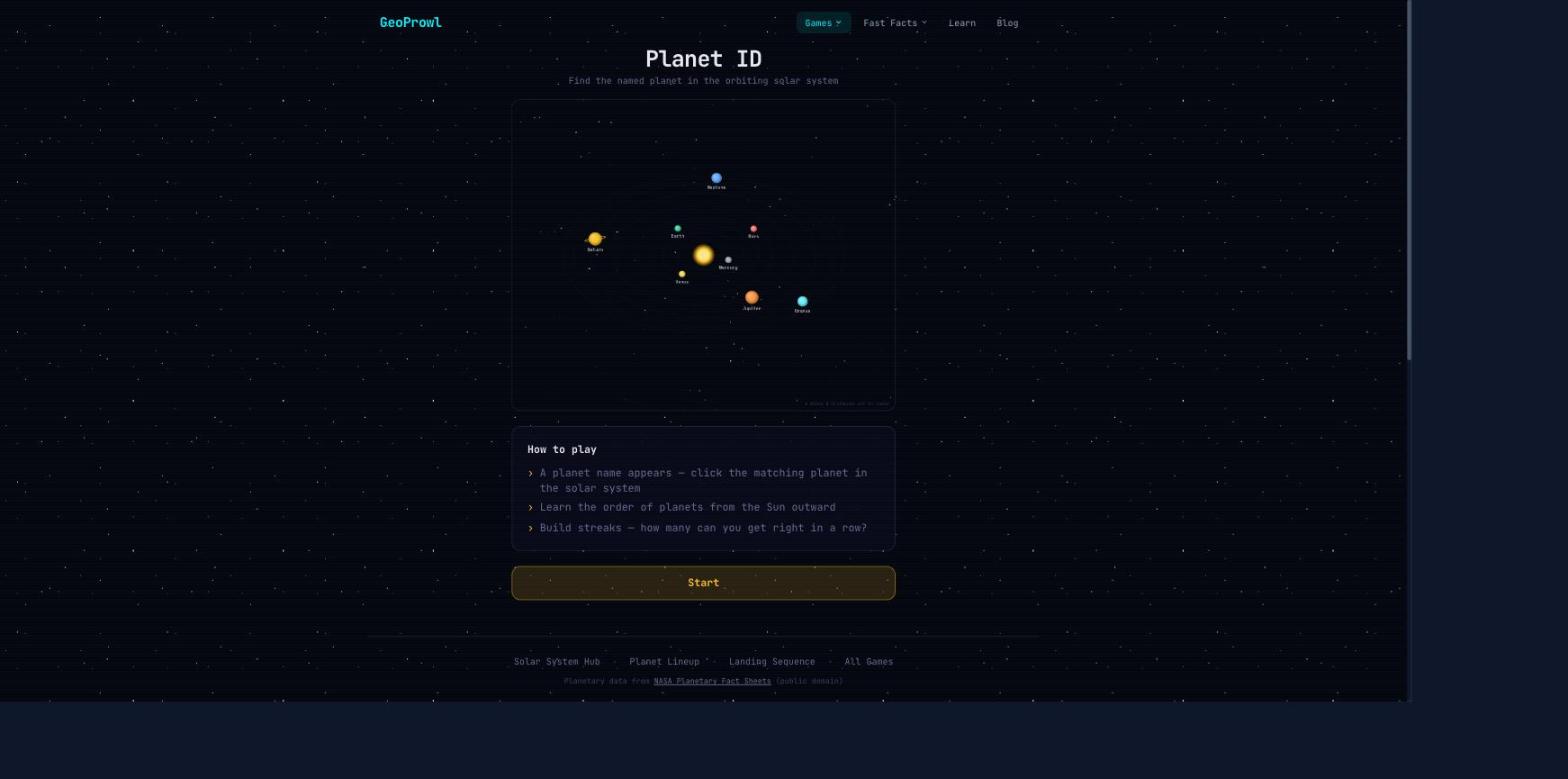
- Day 11 — Order from the Sun. Open with Planet ID. After a few rounds, teach the mnemonic “My Very Educated Mother Just Served Us Nachos” and have the class say it together.
- Day 12 — Biggest and smallest. Scale Detective — simple “which is bigger” questions. Skip any round that asks about distance in miles; focus on the visual size comparisons only.
- Day 13 — One planet, three facts. Each student picks one planet from Fast Facts: Planets and records three facts: its order from the Sun, how many moons it has, and one thing that makes it different from Earth.
- Day 14 — Rocky or gas? Whole-class sorting activity: call out a planet, students point thumbs-down for rocky and thumbs-up for gas giant. Simple, active, and it sticks.
- Day 15 — Review round. One more round of Planet ID, this time timed. Compare to Day 11 — most students will be noticeably faster.
Week 4 — Synthesis: My State Postcard
Goal: each student produces a one-page postcard for their chosen state — a drawn state outline and two data points on the front, a short message to a pretend pen pal on the back. This is a CCSS.W.3.7 short research project in a format third graders actually enjoy finishing.
- Day 16 — Pick and plan. Students pick a state (limit duplicates to two per state in classroom settings). Show the rubric (see Assessments section below).
- Day 17 — Data hunt. Students revisit their state's Fast Facts page and record two required data points plus one optional fun fact.
- Day 18 — Draw the front. Students draw the state outline (a simple laminated tracing template works well) and label its capital, then add their two data points as short captions.
- Day 19 — Write the back. Students write 2–3 sentences to a pretend pen pal describing their state, using a sentence frame if needed: “Dear friend, I live in ___. We have ___ people and ___ National Parks. You should visit because ___.”
- Day 20 — Share and play. Students read their postcard aloud in small groups. Whole class plays one celebratory round of GeoZone State Showdown to close the unit.
4. Cross-curricular tie-ins
The integration is deliberate, not decorative — each moment uses one skill in service of another:
- Math + geography: the Day 9 class bar graph turns real Fast Facts numbers (National Park counts by state) into a 3.MD.B.3 scaled bar graph the class builds together.
- Math + science: Scale Detective's biggest-vs-smallest comparisons give students a first, low-stakes taste of multi-digit magnitude before they meet it formally in Grade 4's Scale Detective work with distances.
- Reading + everything: the Day 8 data hunt and Day 17 postcard research both require reading a real page for information (RI.3.1) rather than being handed the numbers — the skill transfers to any subject.
- Social studies + writing: the postcard's pen-pal framing turns a geography fact sheet into a small piece of persuasive writing (“you should visit because...”), an early and gentle version of the civics-and-geography connection the Grade 4 unit makes explicit.
5. Assessments
Three formative checkpoints track growth during the unit; the postcard project is the single summative artifact. At this grade, growth across the unit matters more than any single score.
Formative (during the unit)
- Day 5 Ratio Kitchen score. Target: complete 5 of 8 rounds correctly. Below that means more hands-on doubling practice before week 2 begins.
- Day 6 vs. Day 10 Just States attempts. Target: at least 5 more states correct on the second attempt. This is the growth metric, not an absolute score.
- Day 15 Planet ID timed round. Target: name at least 6 of 8 planets correctly. This confirms week 3's exposure goal landed.
Summative (end of unit)
- My State Postcard. Rubric points: recognizable state outline and labeled capital (2), two accurate data points (2), 2–3 sentence message on the back (2). Total /6 — kept simple and fast to grade.
6. Differentiation
The same three groups need accommodation as in the Grade 4 unit, adjusted for a younger age band:
- Below grade level in math: allow a hundreds chart or counters during Ratio Kitchen. For the postcard project, reduce required data points from two to one.
- English-language learners: Just States and Just Capitals are language-light by design. For the postcard, provide the sentence frame from Day 19 as a fill-in-the-blank rather than an open prompt.
- Advanced learners: let them attempt Ratio Kitchen's Medium tier (introduces simple fractions) as a preview of the Grade 4 unit. For the postcard, require three data points and a comparison to one neighboring state.
7. Course materials
Equipment needs are minimal — a device with a browser and paper for the postcard project cover the essentials. A few extras help:
- A laminated US map. Third graders benefit from the same wall or desk map used in Grade 4, just with lower expectations for how much of it they label unaided.
- Measuring cups (optional). For Day 1, seeing a physical cup fill up makes “double the recipe” concrete before it becomes an abstract multiplication fact.
- A state-outline tracing template. Makes Day 18's drawing step fast and consistent — most teacher supply sites have free printable state outlines.
- A cheap inflatable planet set or poster. Physical reference matters even more at this age than it did for the Grade 4 unit.
8. For homeschool parents
This unit compresses naturally to about 12 sessions across 2–3 weeks in a one-on-one homeschool setting. A few adaptations:
- Skip the diagnostic. If you already know your child's multiplication fluency, start Day 1 as a normal teaching day instead of a cold check.
- Combine Days 6 and 7. Just States and Just Capitals work well back-to-back in one sitting.
- Let the postcard grow. With one learner, the postcard can become a small booklet covering two or three states instead of one.
- Multi-grade families: pair a younger sibling on the simpler Africa map game during the geography week, and an older sibling on the Grade 4 unit plan in parallel — both units use the same three GeoProwl sections, so the family can play some games together.
9. Frequently asked questions
How long does this unit take to teach?
The plan is built for four weeks at roughly 25–35 minutes per day, five days per week — about 10 hours of total instructional time, a bit shorter than the Grade 4 unit since third graders' attention spans are shorter. Homeschool families typically compress this into three weeks by combining the shorter activities.
Which Common Core and NGSS standards does it cover?
Primary coverage: CCSS.MATH.3.OA.A.1 and 3.OA.A.3 (multiplication and division within 100), CCSS.MATH.3.NBT.A.2 (add and subtract within 1000), CCSS.MATH.3.MD.B.3 (scaled picture and bar graphs), CCSS.ELA-LITERACY.RI.3.1 (asking and answering questions about a text), and CCSS.ELA-LITERACY.W.3.7 (short research projects). Social studies coverage maps to the C3 framework standard D2.Geo.2.3-5. The solar system week previews NGSS 5-ESS1-1 as an early exposure activity, not a mastery expectation — see the note in the standards table below.
Does this work without internet access?
Most of the games are best played in a browser, but nothing requires more than a single shared classroom device — pair students at one screen and rotate. The postcard project can be completed entirely on paper once the data-hunt step is done.
What if my students are below grade level in math?
Ratio Kitchen's Easy tier only asks students to double or triple a recipe — no fractions, just repeated addition and simple multiplication facts. Students who aren't fluent with multiplication yet can use a hundreds chart or skip-count aloud while playing. Nothing in this plan requires reading above a Grade 2 level, and the postcard project accepts drawings in place of sentences for students who need it.
How do I assess student learning if scores are not enough?
The Assessments section below lists three formative checkpoints and one summative project. Game scores are evidence but not the only evidence — the unit culminates in a 'My State Postcard,' a one-page student-built artifact that serves as the summative work sample. A simple three-point rubric is included.
How does this connect to the Grade 4 unit?
This unit is deliberately a bridge. It uses the same three GeoProwl sections as the Grade 4 plan — Figure It Out, GeoZone, and Solar System — but stays in whole numbers instead of fractions and trades the longer State Snapshot Report for a shorter postcard format. A student who finishes this unit confidently is ready to start the Grade 4 unit plan the following year without a gap.
Start the unit
Day 1 begins with one Easy round.
Open Ratio Kitchen and start the diagnostic.
Open Ratio Kitchen →