March 18, 2026
The Math Inside a Beehive: Why Honeycombs Are Hexagons
Crack open a beehive and you'll find one of the most elegant geometric structures in nature: row after row of perfectly uniform hexagonal cells, each angled precisely 13 degrees from horizontal to prevent honey from dripping out. Bees build this structure in complete darkness, without rulers or blueprints, using nothing but wax secreted from their own bodies. Mathematicians spent over 2,000 years trying to prove what bees seemed to already know — that hexagons are the optimal shape for the job.
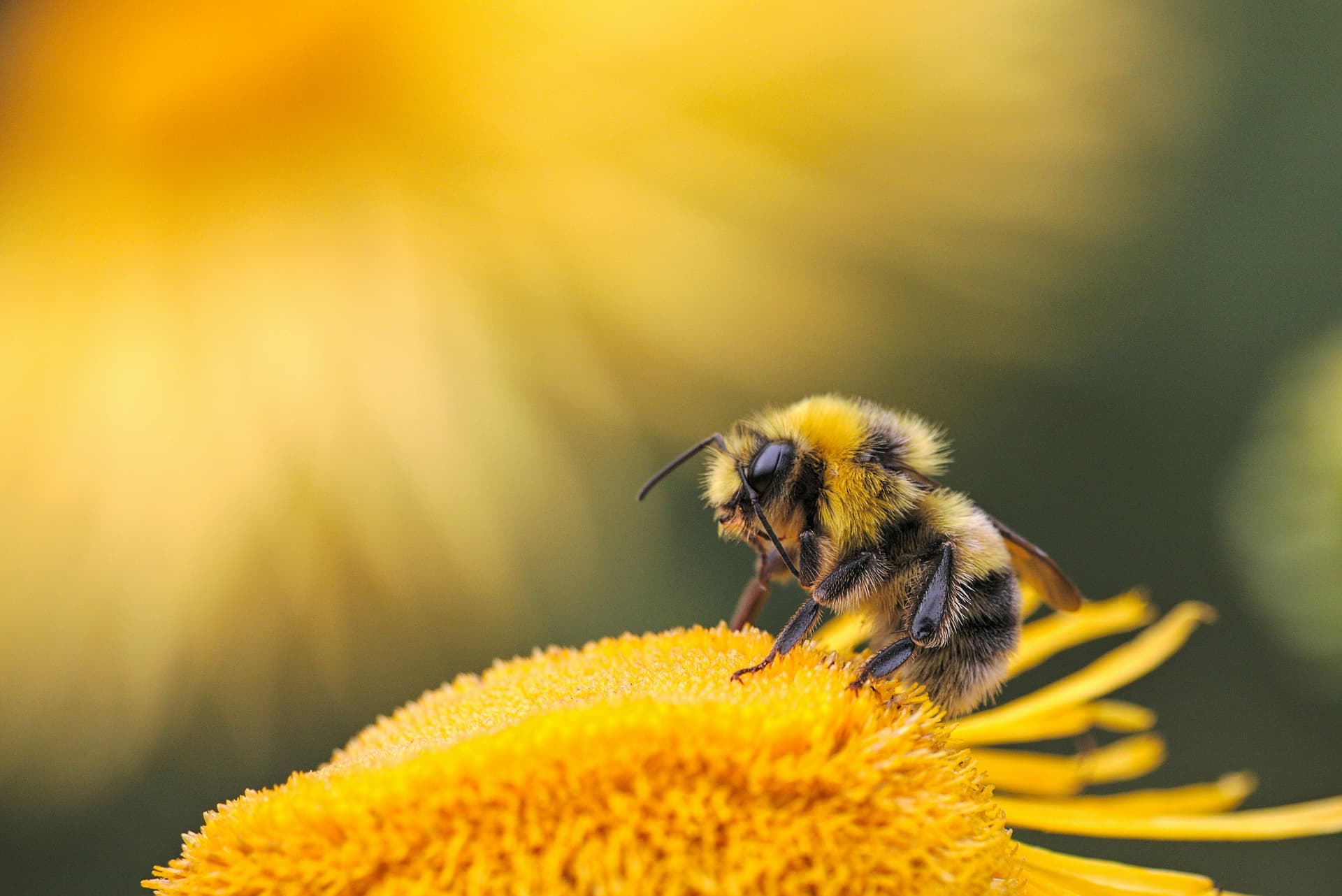
Photo credit: Unsplash
The Honeycomb Conjecture
The question is deceptively simple: if you need to divide a flat surface into cells of equal area using the least total perimeter, what shape should the cells be? The ancient Greek mathematician Pappus of Alexandria posed this problem around 36 AD and conjectured that the answer was regular hexagons. He noted that bees seemed to have figured this out already, writing that bees "have a certain geometrical forethought" in their construction.
For centuries, mathematicians believed Pappus was right but couldn't prove it rigorously. The difficulty lies in the sheer number of possible tilings. You can tile a plane with equilateral triangles, squares, or regular hexagons — these are the only three regular polygons that do it. But you can also tile with irregular shapes, curved boundaries, or combinations of different shapes. Proving that hexagons beat every possible alternative, including shapes nobody had thought of yet, required ruling out an infinite set of competitors.
The proof finally came in 1999, when American mathematician Thomas Hales published a rigorous demonstration that the regular hexagonal grid is indeed the most efficient way to partition a plane into equal areas with the minimum total perimeter. The proof was 19 pages long and used a combination of geometric analysis and careful bounding arguments. After more than 2,000 years, Pappus's conjecture became Hales's theorem.
Maximum Storage, Minimum Wax
To understand why this matters for bees, you need to understand the economics of wax. Beeswax is biologically expensive to produce. Worker bees secrete wax from glands on their abdomens, and it takes approximately 6 to 7 pounds of honey to produce a single pound of wax. Since honey is the colony's primary energy store — representing thousands of hours of foraging labor — every gram of wax used in construction has a real caloric cost.
This creates a clear optimization problem: build cells that hold the maximum volume of honey while using the minimum amount of wax for the walls. Let's compare the three regular tilings. If you build cells with a fixed area of, say, one square centimeter, triangular cells require a total wall perimeter of about 4.56 cm. Square cells need 4.00 cm. Hexagonal cells need only 3.72 cm. That's roughly 7 percent less wax than squares and 18 percent less than triangles for the same storage area. Across an entire comb containing thousands of cells, those savings add up to a significant amount of honey that doesn't need to be converted to wax.
There's a structural advantage too. Hexagonal cells share every wall with an adjacent cell, and each wall intersection involves exactly three walls meeting at 120-degree angles. This three-way junction is inherently stable — it distributes stress evenly and resists deformation. The result is a structure that is both lightweight and remarkably strong. Honeycomb panels inspired by this geometry are used in aerospace engineering, where the same principle — maximum strength per unit weight — is critical for aircraft and spacecraft construction.
How Bees Actually Build
Knowing that hexagons are mathematically optimal is one thing. Explaining how bees — insects with brains containing fewer than a million neurons — construct them with precision is another. The building process begins when worker bees cluster together in a "festoon," hanging in chains from the top of the hive cavity. Their body heat raises the local temperature to about 40 degrees Celsius (104 F), which is critical for wax manipulation.
Wax scales are secreted from glands on the underside of the abdomen, then chewed and mixed with enzymes to soften them. Workers press the pliable wax into place, building cell walls from the top down. Here's where it gets interesting: when bees first deposit wax, the cells are not perfectly hexagonal. High-speed photography and thermal imaging studies have shown that freshly built cells are roughly circular. The hexagonal shape emerges as the wax cools and the circular cells are packed together.
This process is remarkably similar to what happens when you pack soap bubbles together on a flat surface — they naturally form hexagonal patterns at the junctions because hexagons minimize surface tension. The "liquid equilibrium" hypothesis, supported by research published in the Journal of the Royal Society Interface, suggests that bees exploit the physics of warm, semi-molten wax to achieve geometric precision without needing to measure angles or distances. They build roughly, heat the wax, and physics does the rest.
That said, bees are not purely passive participants. They actively control cell size — worker brood cells are about 5.2 to 5.4 mm across, while drone cells are larger at about 6.2 to 6.9 mm. They build transition zones where the two cell sizes meet, using irregular pentagonal cells to smoothly bridge the size difference. And they tilt the entire comb slightly backward so that uncapped cells hold liquid honey without spilling. The combination of physical self-organization and active biological control produces a structure of extraordinary precision.
Hexagons Everywhere
Bees didn't invent hexagonal packing — they stumbled onto a pattern that appears throughout nature and engineering whenever efficiency matters. The basalt columns of the Giant's Causeway in Northern Ireland form hexagonal prisms as lava cools and contracts. The compound eyes of insects are packed with hexagonal ommatidia. Saturn's north pole has a persistent hexagonal storm pattern thousands of kilometers across. In every case, hexagons emerge because they're the geometry that minimizes energy or material for a given constraint.
Engineers have embraced this principle explicitly. Honeycomb sandwich panels — two thin skins bonded to a hexagonal core — are standard in aerospace, where Boeing and Airbus use them extensively in floor panels, nacelles, and control surfaces. The hexagonal core provides exceptional stiffness-to-weight ratio. Carbon fiber honeycomb panels are up to 90 percent air by volume yet can support loads hundreds of times their own weight. The James Webb Space Telescope's primary mirror is composed of 18 hexagonal segments, chosen because hexagons tile without gaps and can approximate a curved surface through slight individual tilting.
Even cellular networks use hexagonal geometry. Cell towers are arranged in hexagonal grids because this pattern provides complete coverage of an area with the fewest towers and the least overlap between cells. The same math that governs beeswax efficiency governs wireless signal propagation. Pappus would have appreciated the universality.
How Much Honey Fits in a Hive
The practical output of all this geometric efficiency is honey — and the numbers are impressive. According to the USDA National Agricultural Statistics Service, the United States produced approximately 125 million pounds of honey in 2024 from about 2.7 million managed colonies. That works out to roughly 46 pounds per colony on average, though strong colonies in good nectar years can produce 80 to 100 pounds or more.
A standard Langstroth deep frame — the most common frame size in American beekeeping — holds about 8 to 10 pounds of honey when fully capped. Each frame contains roughly 7,000 hexagonal cells per side, for about 14,000 cells total. A single cell holds approximately 0.4 milliliters of honey, which doesn't sound like much until you multiply it across an entire hive. A productive colony may fill 40 to 60 frames over a season — each one a masterwork of hexagonal engineering.
The USDA Economic Research Service values US honey production at over $300 million annually at the farm gate, with retail prices typically ranging from $7 to $12 per pound for conventional honey and significantly more for specialty varietals like manuka, sourwood, or tupelo. Every dollar of that value starts with a wax hexagon built in the dark by an insect that weighs less than a paperclip. The efficiency of the hexagonal comb is not just an elegant mathematical curiosity — it's the structural foundation of a multi-hundred-million-dollar agricultural product.
Build Your Own
Hexagons are the shape of efficiency — and now they're the shape of a memory game. In Honeycomb Builder, you'll match patterns on a hexagonal grid that grows more complex with each level. The geometry that bees use to store honey, you'll use to test your recall.
Play Honeycomb Builder →Sources
- Hales, T. C. (2001). "The Honeycomb Conjecture." Discrete & Computational Geometry, 25, 1-22.
- USDA National Agricultural Statistics Service. "Honey Report, March 2025." nass.usda.gov.
- USDA Economic Research Service. "Sugar and Sweeteners Yearbook Tables." ers.usda.gov.
- Karihaloo, B. L., et al. (2013). "Honeybee combs: how the circular cells transform into rounded hexagons." Journal of the Royal Society Interface, 10(86).
- Pappus of Alexandria. Mathematical Collection, Book V (c. 340 AD).
- Zhang, K., et al. (2015). "On the mechanism of honeycomb cell formation." Physical Review Letters, 116(3).