July 19, 2026
How Many Landlocked Countries Are There? A Complete Guide to All 44
44 countries in the world are landlocked — no coastline on any ocean. Use the table below to browse them by continent, or jump to the FAQ for the most-searched questions ("Is Switzerland landlocked?", "What's a doubly landlocked country?", "Why is Bolivia landlocked?"). If you came here from our guide to landlocked US states — same idea, much bigger scale: Africa alone has 16 landlocked countries, more than any other continent.
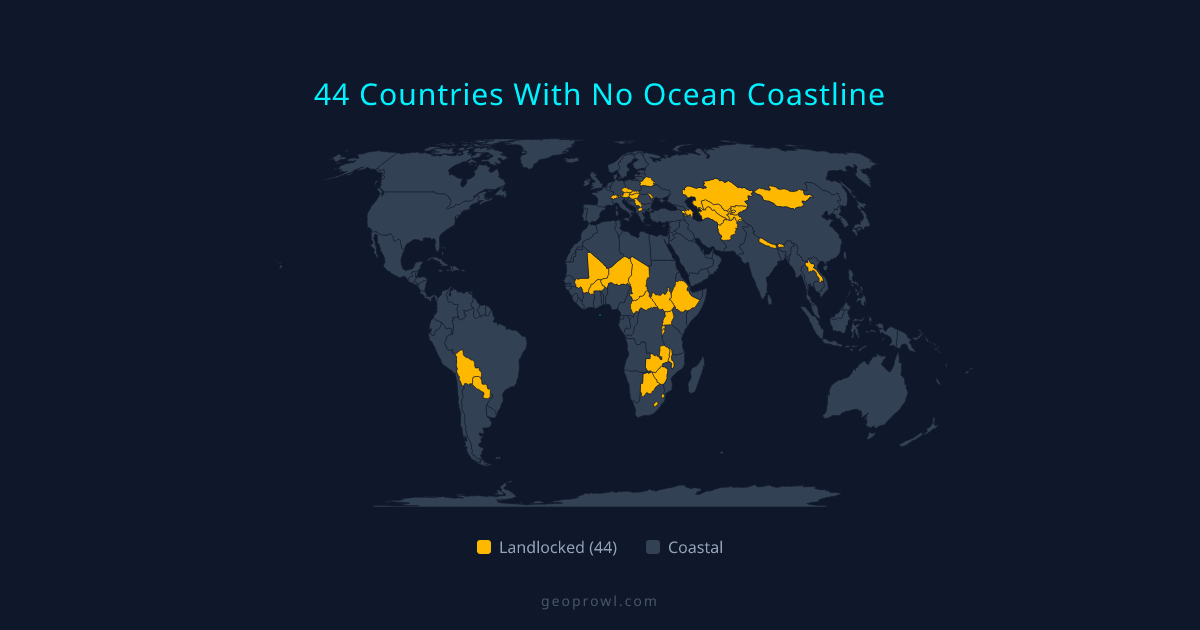
The Direct Answer: 44 Landlocked Countries
44 of the world's roughly 195 sovereign countries have no ocean coastline. They break down by continent as: Africa (16), Europe (14), Asia (12), and South America (2) — just Bolivia and Paraguay. North America (including Central America and the Caribbean), Oceania, and Antarctica have zero landlocked countries; every nation there touches an ocean.
The count varies slightly by source — some say 43, some say 49 — because of how partially recognized states get counted. Kosovo, South Ossetia, and Transnistria are all landlocked but aren't universally recognized UN member states, so most encyclopedic sources (and this guide) count 44 landlocked sovereign countries and treat the de facto states as a footnote rather than part of the headline number.
Definition, for this guide: a country is landlocked if it has no coastline on an ocean or a sea that connects directly to one. Closed inland seas don't count — that's why Kazakhstan, Turkmenistan, and Azerbaijan are landlocked despite bordering the Caspian Sea. The Caspian has no natural outlet to any ocean, so geographically it's a giant saltwater lake, not a sea. It's the same logic as the Great Lakes ruling in our US states guide — Ohio and Michigan are landlocked despite touching Lake Erie and Lake Michigan, for exactly the same reason.
Find a Country
Pick any of the 44 landlocked countries to see it on the map, its capital and neighbors, and whether it's a UN-classified LLDC.
All 44 Landlocked Countries, by Continent
Grouped continent by continent, most landlocked countries first.
Africa (16)
| Country | Capital | UN LLDC? |
|---|---|---|
| Botswana | Gaborone | Yes |
| Burkina Faso | Ouagadougou | Yes |
| Burundi | Gitega (official); Bujumbura (economic) | Yes |
| Central African Republic | Bangui | Yes |
| Chad | N'Djamena | Yes |
| Eswatini | Mbabane (administrative); Lobamba (legislative/royal) | Yes |
| Ethiopia | Addis Ababa | Yes |
| Lesotho | Maseru | Yes |
| Malawi | Lilongwe | Yes |
| Mali | Bamako | Yes |
| Niger | Niamey | Yes |
| Rwanda | Kigali | Yes |
| South Sudan | Juba | Yes |
| Uganda | Kampala | Yes |
| Zambia | Lusaka | Yes |
| Zimbabwe | Harare | Yes |
Europe (14)
| Country | Capital | UN LLDC? |
|---|---|---|
| Andorra | Andorra la Vella | No |
| Austria | Vienna | No |
| Belarus | Minsk | No |
| Czech Republic | Prague | No |
| Hungary | Budapest | No |
| Liechtenstein | Vaduz | No |
| Luxembourg | Luxembourg City | No |
| Moldova | Chișinău | Yes |
| North Macedonia | Skopje | Yes |
| San Marino | City of San Marino | No |
| Serbia | Belgrade | No |
| Slovakia | Bratislava | No |
| Switzerland | Bern | No |
| Vatican City | Vatican City | No |
Asia (12)
| Country | Capital | UN LLDC? |
|---|---|---|
| Afghanistan | Kabul | Yes |
| Armenia | Yerevan | Yes |
| Azerbaijan | Baku | Yes |
| Bhutan | Thimphu | Yes |
| Kazakhstan | Astana | Yes |
| Kyrgyzstan | Bishkek | Yes |
| Laos | Vientiane | Yes |
| Mongolia | Ulaanbaatar | Yes |
| Nepal | Kathmandu | Yes |
| Tajikistan | Dushanbe | Yes |
| Turkmenistan | Ashgabat | Yes |
| Uzbekistan | Tashkent | Yes |
South America (2)
| Country | Capital | UN LLDC? |
|---|---|---|
| Bolivia | Sucre (constitutional); La Paz (seat of government) | Yes |
| Paraguay | Asunción | Yes |
Want to test yourself instead of just reading the list? Try clicking every country from memory in our Africa, Europe, Asia, or South America geography quizzes.
The Most-Searched Countries, Answered Plainly
Is Switzerland landlocked? Yes. It borders five countries and no ocean — though the Rhine gives it river access to the North Sea via the Port of Basel.
Is Austria landlocked? Yes. Austria borders eight countries in Central Europe and has no ocean coastline.
Is Mongolia landlocked? Yes — bordered by just two countries, Russia and China, and nothing else.
Is Kazakhstan landlocked? Yes, even though it borders the Caspian Sea — the Caspian is a closed inland sea with no ocean outlet. Kazakhstan is the largest landlocked country on Earth by area.
Is Ethiopia landlocked? Yes — and it's the most populous landlocked country in the world. Ethiopia had a Red Sea coastline until Eritrea gained independence in 1993.
Is Nepal landlocked? Yes. Nepal is wedged between China and India, and contains Mount Everest — the highest point on Earth is in a country with no coastline at all.
Is Chad landlocked? Yes. Chad borders six countries in Central Africa and no ocean; it's named for Lake Chad, a shrinking inland lake shared with three neighbors.
Is Bolivia landlocked? Yes — but it wasn't always. See Bolivia and the Sea below.
Landlocked vs. LLDC — Why the Numbers Don't Match
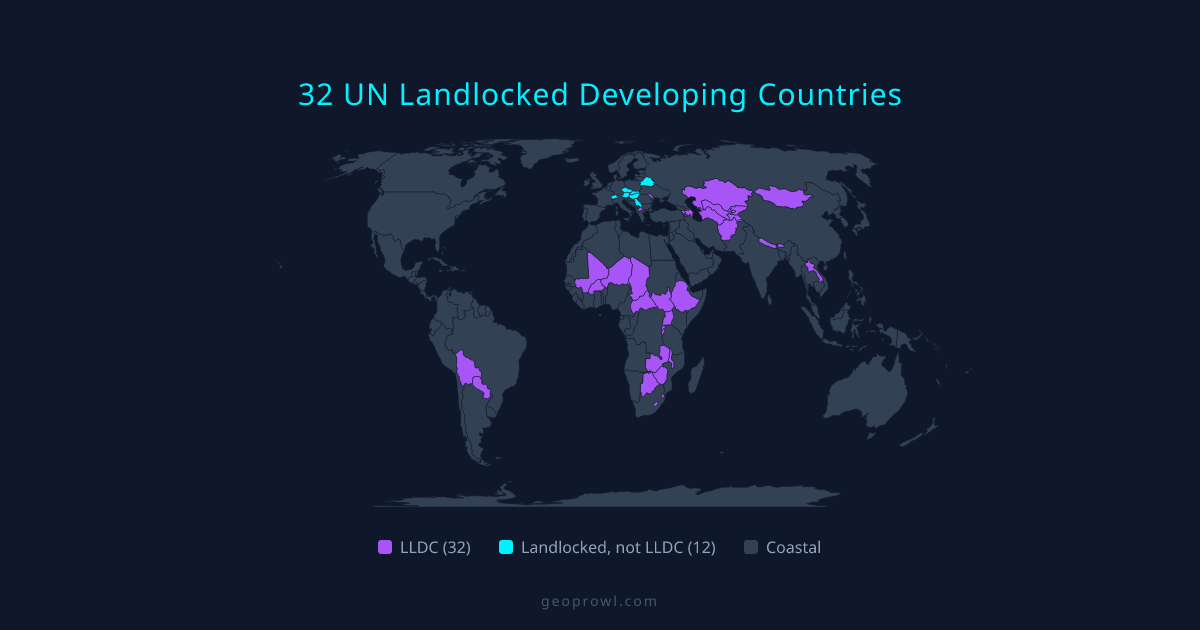
"Landlocked" is pure geography — a country with no ocean coastline. "LLDC" stands for Landlocked Developing Country, a UN and UNCTAD trade-policy classification for landlocked nations that are also developing economies. It exists because landlocked developing countries face real, measurable costs — UNCTAD estimates their international freight costs can run up to three times higher than coastal peers, since every shipment depends on crossing at least one other country's territory, ports, and customs.
Of the 44 landlocked countries, 32 are UN-designated LLDCs — 16 in Africa, 12 in Asia, 2 in Latin America (Bolivia and Paraguay), and 2 in Europe (Moldova and North Macedonia). The other 12 — Andorra, Austria, Belarus, Czechia, Hungary, Liechtenstein, Luxembourg, San Marino, Serbia, Slovakia, Switzerland, and Vatican City — are landlocked but not LLDCs, mostly because they're wealthy, well-integrated European economies where the trade-cost problem the classification was built for simply doesn't apply.
The Double-Landlocked Countries
A doubly landlocked country is one whose every neighbor is also landlocked — you'd have to cross at least two international borders to reach any coastline. Only two countries in the world meet that bar:
- Uzbekistan — One of only two doubly landlocked countries on Earth — every one of its five neighbors is itself landlocked.
- Liechtenstein — The world's smallest doubly landlocked country — surrounded only by Switzerland and Austria, both themselves landlocked.
Three more countries are worth knowing even though they don't meet the doubly landlocked bar: Lesotho, San Marino, and Vatican City are enclaves — each surrounded entirely by a single other country (South Africa, Italy, and Italy again, respectively). An enclave and a doubly landlocked country are different things: Lesotho's only neighbor, South Africa, has an ocean coastline, so reaching the sea from Lesotho only means crossing one border, not two.
Bolivia and the Sea
Bolivia is the clearest example of a country that became landlocked rather than starting out that way. Until 1879, Bolivia held a stretch of Pacific coastline in the Atacama Desert. The War of the Pacific (1879–1884), fought between Bolivia, Peru, and Chile largely over nitrate and mineral deposits, ended with Chile annexing that territory. Bolivia has been landlocked ever since.
The loss is still a live political issue, not just history. Bolivia marks Día del Mar ("Day of the Sea") every March 23, and it maintains a small navy — based on Lake Titicaca and the Paraguay River — that trains for the day the country might regain coastal access. Bolivia and Chile have gone to the International Court of Justice over the dispute as recently as 2018 (Bolivia lost that case, but the underlying claim hasn't gone away).
Bolivia is also a good reminder that "landlocked" doesn't mean "isolated." Its seat of government, La Paz, is the highest capital city in the world at roughly 3,640 meters (11,975 feet) above sea level — closer to the clouds than to any ocean.
The Largest, Smallest, and Most Extreme
Largest by area: Kazakhstan — roughly 2.7 million km², bigger than all of Western Europe combined, and the 9th largest country in the world overall despite having no coastline.
Smallest: Vatican City — under half a square kilometer, and also the smallest country on Earth, landlocked or not.
Most populous: Ethiopia — over 100 million people, more than any other landlocked country, and among the most populous countries in Africa overall.
Farthest from any ocean: Kyrgyzstan — commonly cited as the country whose landmass sits farthest, on average, from any coastline anywhere in the world, deep in the mountains of Central Asia.
Most neighbors: Zambia — borders eight other countries (DR Congo, Tanzania, Malawi, Mozambique, Zimbabwe, Botswana, Namibia, and Angola), more than any other landlocked country in the world.
Why Landlocked Status Matters
For a handful of wealthy European nations, being landlocked is a footnote — Switzerland and Austria rank among the world's richest countries per capita. But for many of the 32 LLDCs, no direct sea access is a genuine economic constraint: every export has to cross a neighbor's territory, clear an extra set of customs, and pay for the use of a port that isn't theirs. UNCTAD estimates this can push freight costs to roughly three times what coastal neighbors pay for the same distance.
It also shapes geography and culture in ways worth knowing beyond the economics: Nepal holds the world's highest peak, Bolivia the world's highest capital, Kazakhstan more landmass than any other landlocked nation, and Mongolia one of the lowest population densities anywhere. For the US side of this same question, see which US states are landlocked, test what you know in our geography trivia night questions (it opens with a doubly landlocked question), or dig into the politics of borders in our AP Human Geography study guide.