May 2, 2026
Is Your State Landlocked? A Complete Guide to All 26
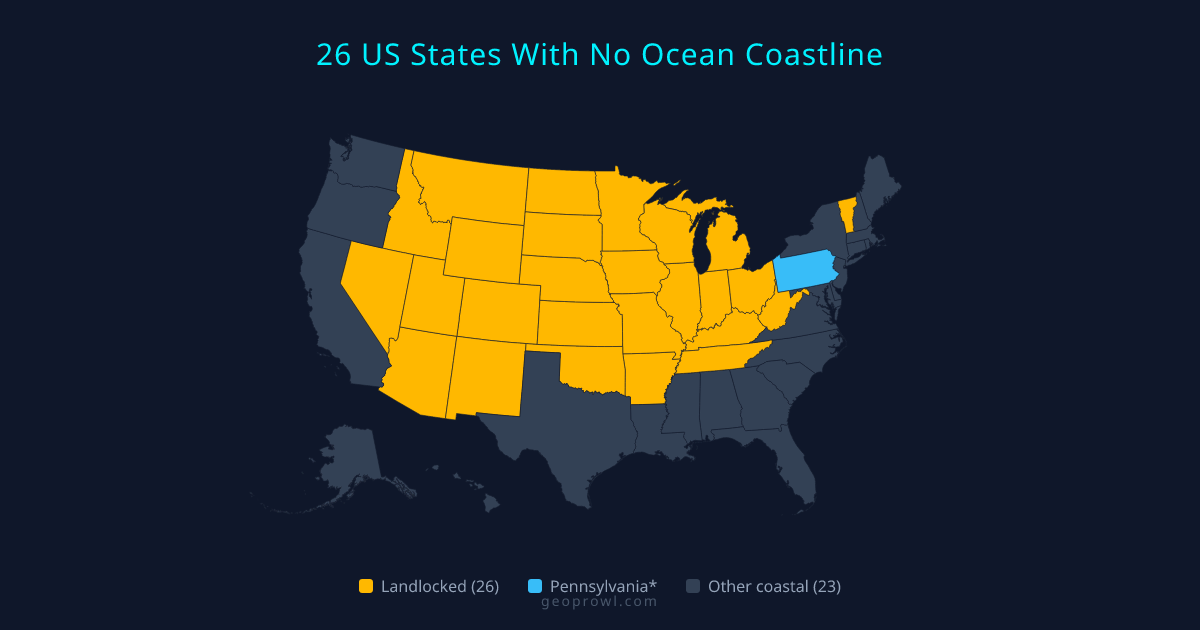
26 of the 50 US states are landlocked, meaning they have no ocean coastline. Use the table below to find your state — and skip down to the FAQ for the most-searched specific questions ("Is Ohio landlocked?", "Is Wisconsin landlocked?", "Are Great Lakes states landlocked?"). The short version: yes, the Great Lakes states are landlocked under the standard definition, since lakes do not count as ocean coastline. The longer version covers why that distinction matters and which state is the most landlocked of all.
The Direct Answer: 26 Landlocked States
Of the 50 US states, 26 have no ocean coastline. The remaining 24 touch the Atlantic, Pacific, Arctic, or Gulf of Mexico. The 26 landlocked states are: Arizona, Arkansas, Colorado, Idaho, Illinois, Indiana, Iowa, Kansas, Kentucky, Michigan, Minnesota, Missouri, Montana, Nebraska, Nevada, New Mexico, North Dakota, Ohio, Oklahoma, South Dakota, Tennessee, Utah, Vermont, West Virginia, Wisconsin, and Wyoming.
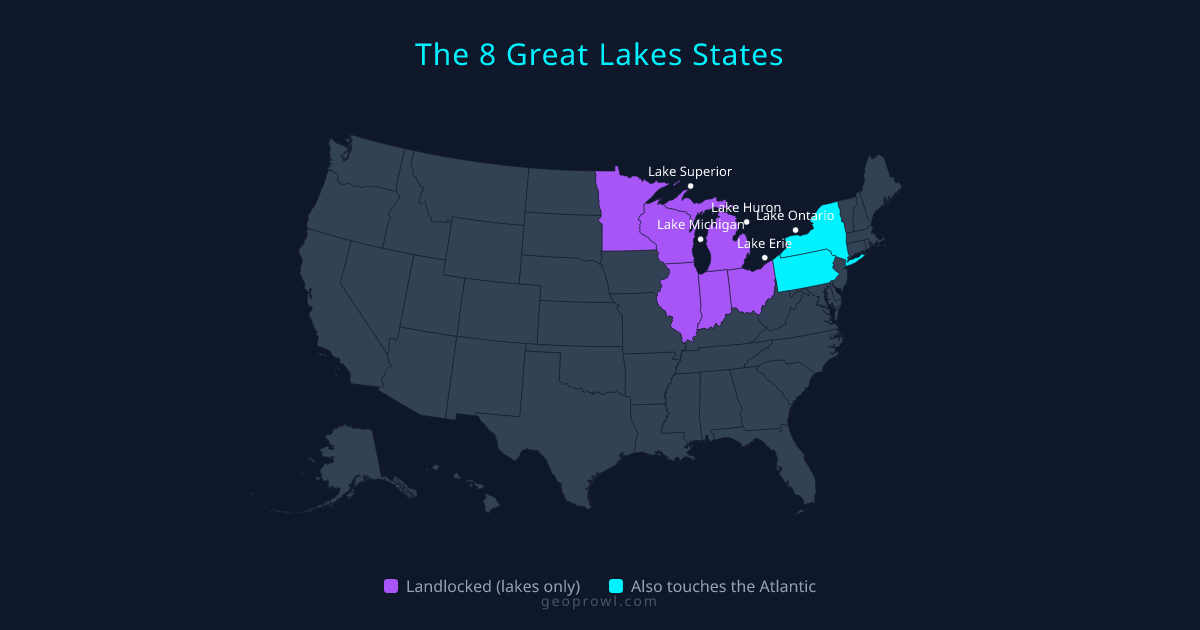
Six of those 26 — Illinois, Indiana, Michigan, Minnesota, Ohio, and Wisconsin — have Great Lakes shoreline. Whether to count them as "landlocked" is the question that drives most of the search traffic on this topic. The geographic answer is yes: the Great Lakes are inland freshwater lakes, not oceans. The economic answer is more nuanced — the St. Lawrence Seaway connects the lakes to the Atlantic, so port cities like Chicago, Cleveland, and Duluth function as international seaports.
Definition, for this guide: a state is landlocked if it has no coastline on an ocean, or on a tidal bay/estuary that flows directly into one. Freshwater lakes do not count — not even the Great Lakes, and not even where oceangoing ships can reach them via a canal. That distinction is why Pennsylvania is not landlocked despite never touching the open Atlantic, while Ohio and Michigan are landlocked despite Great Lakes shoreline. More on that below.
Find Your State
Pick any state to see it on the map, whether it's landlocked, and the nearest body of water.
All 50 States: Landlocked or Coastal?
Find your state. Click any state name to see its full Fast Facts page with population, climate, agriculture, and health data.
| State | Landlocked? | What it borders |
|---|---|---|
| Alabama | No | Gulf of Mexico |
| Alaska | No | Pacific, Arctic |
| Arizona | Yes | — |
| Arkansas | Yes | — |
| California | No | Pacific Ocean |
| Colorado | Yes | — |
| Connecticut | No | Atlantic Ocean |
| Delaware | No | Atlantic Ocean |
| Florida | No | Atlantic, Gulf |
| Georgia | No | Atlantic Ocean |
| Hawaii | No | Pacific Ocean |
| Idaho | Yes | — |
| Illinois | Yes | Lake Michigan only |
| Indiana | Yes | Lake Michigan only |
| Iowa | Yes | — |
| Kansas | Yes | — |
| Kentucky | Yes | — |
| Louisiana | No | Gulf of Mexico |
| Maine | No | Atlantic Ocean |
| Maryland | No | Atlantic Ocean |
| Massachusetts | No | Atlantic Ocean |
| Michigan | Yes | Great Lakes only |
| Minnesota | Yes | Lake Superior only |
| Mississippi | No | Gulf of Mexico |
| Missouri | Yes | — |
| Montana | Yes | — |
| Nebraska | Yes | — |
| Nevada | Yes | — |
| New Hampshire | No | Atlantic Ocean |
| New Jersey | No | Atlantic Ocean |
| New Mexico | Yes | — |
| New York | No | Atlantic, Great Lakes |
| North Carolina | No | Atlantic Ocean |
| North Dakota | Yes | — |
| Ohio | Yes | Lake Erie only |
| Oklahoma | Yes | — |
| Oregon | No | Pacific Ocean |
| Pennsylvania | No | Delaware River→Atlantic (no open coastline); Lake Erie |
| Rhode Island | No | Atlantic Ocean |
| South Carolina | No | Atlantic Ocean |
| South Dakota | Yes | — |
| Tennessee | Yes | — |
| Texas | No | Gulf of Mexico |
| Utah | Yes | — |
| Vermont | Yes | — |
| Virginia | No | Atlantic Ocean |
| Washington | No | Pacific Ocean |
| West Virginia | Yes | — |
| Wisconsin | Yes | Great Lakes only |
| Wyoming | Yes | — |
The Most-Searched States, Answered Plainly
Is Ohio landlocked? Yes. Ohio borders Lake Erie to the north and the Ohio River to the south, but neither is an ocean coastline. See Ohio Fast Facts.
Is Wisconsin landlocked? Yes. Wisconsin borders Lake Superior to the north and Lake Michigan to the east. Both are Great Lakes, not oceans. See Wisconsin Fast Facts.
Is Michigan landlocked? Yes — and it has more Great Lakes shoreline than any other state, touching four of the five (Superior, Michigan, Huron, Erie). It is the most coastline-rich landlocked state. See Michigan Fast Facts.
Is Tennessee landlocked? Yes. Tennessee borders eight other states (tied with Missouri for the most state neighbors of any state) and no ocean. See Tennessee Fast Facts.
Is Pennsylvania landlocked? No. Pennsylvania has a small Atlantic coastline along Delaware Bay (about 57 miles) and borders Lake Erie at its northwest tip — making it the only US state that touches both the Atlantic Ocean and the Great Lakes.
Is Vermont landlocked? Yes — the only landlocked state in New England. Vermont borders Lake Champlain to the west.
The Great Lakes Question
The Great Lakes states sit in an interesting middle ground. Geographically they are landlocked: the lakes are freshwater, not saltwater, and not part of any ocean. But economically and historically, the Great Lakes function as inland seas. The St. Lawrence Seaway, opened in 1959, lets oceangoing ships sail from the Atlantic all the way into Lake Superior. Duluth, Minnesota — far inland on a freshwater lake — is one of the busiest ports in the United States by tonnage.
For the standard geographic definition (used by USGS, Census Bureau, and most encyclopedias), Great Lakes states are landlocked. That is the definition this guide uses. If you are answering an exam question or trivia, "landlocked" almost always means "no ocean coast" — and Lake Erie does not count.
The Pennsylvania Exception: Coastal Without Touching the Open Ocean
Pennsylvania is the trickiest case in this guide. Look at a map and it doesn't appear to touch the ocean the way New Jersey or Delaware do — its southeastern corner just brushes a narrow strip of water near Philadelphia. That leads plenty of people to assume Pennsylvania is landlocked. It isn't.
That narrow strip is the Delaware River and Delaware Bay, and it is tidal — it rises and falls with the ocean and flows directly, uninterrupted, into the Atlantic. Oceangoing cargo ships sail up the Delaware from the open Atlantic to the Port of Philadelphia every day. About 57 miles of Pennsylvania's border sits on this tidal, ocean-connected water, which is enough to count as real coastline under the definition above — Pennsylvania has ocean access, just not a stretch of open Atlantic shoreline.
Compare that to Lake Erie, which also touches Pennsylvania's northwest corner. Lake Erie is freshwater and, aside from the man-made St. Lawrence Seaway (a canal-and-lock system, not a natural tidal channel), has no direct connection to any ocean — the same reason Ohio, Michigan, and the other Great Lakes states are landlocked. Pennsylvania is the only US state that touches both kinds of water: a freshwater Great Lake that doesn't count, and a tidal Atlantic estuary that does. That makes it the clearest illustration in the country of where the "landlocked" line actually falls.
The Most Landlocked State in America
Several states compete for the title of "farthest from any ocean." The geographic point in the contiguous United States farthest from any saltwater coast lies in northwestern South Dakota, near the town of Allen on the Pine Ridge Reservation — roughly 1,000 miles from the nearest coastline (the Pacific to the west, the Gulf of Mexico to the south, or Hudson Bay to the north). See South Dakota Fast Facts and Kansas Fast Facts.
By state-center distance to the nearest ocean, Kansas, Nebraska, and South Dakota all crowd the top of the list. The exact answer depends on which definition you use — geographic center, population center, or farthest single point. But the broader truth is the same: there is a band of states running from North Dakota down through the Great Plains where you can drive a thousand miles in any direction and still not see the sea.
Why Landlocked Status Matters
For US states, landlocked status is mostly a geographic curiosity — federal infrastructure, the interstate highway system, and the Great Lakes / Mississippi River network mean that no state is economically isolated. But landlocked status still shapes some real things: weather (continental climates with hot summers and cold winters), navy presence (or absence — Wyoming is famously the only state to have a Navy ship named after it that never visits), and a culture that grows up looking inland.
Several landlocked states pack extraordinary geography. Colorado has the highest mean elevation of any state. Wyoming contains Yellowstone. Utah holds five national parks. Tennessee's topography ranges from the Appalachians to the Mississippi alluvial plain. For more, read about every state's highest and lowest elevation or our Four Corners explainer (where four landlocked states meet at a single point).
Curious how the US compares to the rest of the world? 26 states have no ocean coastline, but so do 44 entire countries — see our complete guide to landlocked countries, including the only 2 "doubly landlocked" nations on Earth and why Bolivia lost its coastline.